Need I say more?
Saturday, July 6, 2024

Sunday, May 19, 2024
Climate requires more attention.
Eliot Jacobson's Climate Work
Eliot Jacobson's Climate Blog is a worthwhile stop on the Internet Superhighway. Prof. Jacobson first came to my notice when I stumbled upon his discussion of the debris flows in Montecito, in my home town of Santa Barbara. As it turns out, Dr. Jacobson was formerly a professor of Mathematics and Computer Science at UCSB, my alma mater. That was cool; but the main attraction was his graphs, representations of climate data. As a science educator, and for personal studies of tides, I have focused a great deal of attention on graphing. To emphasize the usefulness of graphs, I gave students pages of numbers that were at least perplexing and not easy to understand as numbers on a page alone. Graphs bring life to these pages of numbers, and sense. Jacobson is great at it.
His web page at https://climatecasino.net/, and a more recent compendium, I Jump, are worth visiting.
Early Bellweather of the Effect of CO2
Fossil fuel and profit extraction corporations knew relatively early of the effects of the burning of Fossil Fuels. Incredibly, those corporations and greedy barons continue to conceal or obfuscate the truth about Carbon Dioxide and other Greenhouse Gas emissions, taking advantage of the Supreme Court's decision that Corporations are persons, and can therefore contribute an unlimited amount to political campaigns. I was troubled to learn of work by scientists in the employ of fossil fuel centered corporations such as Exxon and Shell, and automobile manufacturers in the late 50s, showing the dire consequences of continued use of such fuels and automobiles driven by internal combustion engines, and that these corporations continued---and to a great extent continue to this day---to build a dynasty, on a foundation of deception of the public, and denial.
Even more remarkable is this document, linked below, written by the chemist Svante Arrhenius, in 1896. This pdf is prefaced by the following description:
Arrhenius’s paper is the first to quantify the contribution of carbon
dioxide to the greenhouse effect (Sections I-IV) and to speculate about
whether variations in the atmospheric concentration of carbon dioxide
have contributed to long-term variations in climate (Section V).
Throughout this paper, Arrhenius refers to carbon dioxide as “carbonic
acid” in accordance with the convention at the time he was writing.
https://www.rsc.org/images/Arrhenius1896_tcm18-173546.pdf
Just another news item
Tuesday, January 16, 2024
Monday, June 5, 2023
A visual history of pandemics from The Bulletin of the Atomic Scientists
In 1996, I scored, bigtime; an improbable life-changing event. I had been staying at the home of a family in Merizo for many months. In order to introduce them to my family, who had flown in from Chuuk, we stopped our rent-a-car at my friends' home, intending a short stop, just for a few minutes.
Their phone (alandline) rang; strangely, it was a call for me! I never received calls on their line. On the other end, a voice asked, would I accept a job on Saipan teaching Health Science? The salary would be sufficient for subsistence, and housing would be provided. Could we be at the Guam airport early the next morning, myself and family?
I could---and probably should---elaborate, contextualize this event. But to cut to the chase, we were at the airport the following morning, and that evening we were comfortable in a temporary lodging provided for us in a local hotel. Things did not go smoothly, but thanks to a wonderful team from the CNMI Public School System we soon had an apartment and I, a job at Marianas High School.
My Health Education job turned into Biology and Environmental Science. Perfect! From the star, teaching in Micronesia involved a heavy dose of Environmental Science. In Chuuk there was a book, but abundant opportunities for focusing on local problems and issues, students were engaged in confronting numerous local issues, often involving the collision course between their tranditional ways and the new economy of money, politics, plastics, frozen food, canned food, monofilament fishing line and nets, the exhustion of fish stocks, encroachment of fishing fleets from around the world, new ideas about consumption... I could go on.
The experience of students on Saipan was a step ahead of those in the other Micronesian entities. The U. N. Trust Territory of the Pacific Islands maintained headquarters on Saipan, reigning over all of those other diverse entities--The Marshall Islands, Kosrae, Pohnpei, Chuuk, Yap, and Palau. The locals on Saipan organized and learned to tap into the massive federal resources. They learned the game of political control, and when the time came for "self-determination" (as mandated by the U. N.), they had a leg up, and already were in the driver's seat.
Development---all of those new or improved trappings referred to in the previous paragraph---was already on track for bigger and better things. This story will probably be told elsewhere, but in all likelihood, the first draft has already been written by those educated by their captors.
My job was not the same on Saipan, then, as it had been in Chuuk. Students from diverse backgrounds and languages had different perspectives, so I was at a disadvantage. The books, surprizingly, since the budget of CNMI PSS was an order of magnitude larger---thanks to the influence of the local population in Territorial political affairs---than the Chuuk State Department of Education. And the Chuuk DOE had 100 schools to deal with! But the books were better in Chuuk. Go figure.
I now had an Internet connection and PC, at home, and devoted a considerable amount of time and energy to developing classroom materials. The new (to me) search engine, Google., made swift work of searching; buton a typical day, I wouild be lucky to find ONE (1) article about any important environmental issue of consequence for the islands. I tell this story to illustrate how much things have changed over the past 25 years, for that is how long it has been. What I really want to show show is a web page I just encountered today, in 2023, of monumental significance to Environmental Science: an article, a visual history of pandemics.
Sunday, May 28, 2023
June Gloom and Doom: manifestations of the Heat of Fusion of Water
Proposing a new blog: "Watching the Ice Melt."
In Environmental Science classes, a goal of mine has been to facilitate understanding of the dynamics of water phase changes. I have portrayed polar ice masses as a buffer to mitigate the worst effects of imbalances in the hear budget of the planet. It has been a few years (ie., "a minute") since I have taught Environmental Science. In the meantime, it has become apparent that the predicted and feared growing imbalances are increasing; and at the same time, I have wondered whether my approach to teaching these important concepts were sufficiently impactful. Ie., did students in my classes understand these important lessons.
I have come recently to use the term "watching the ice melt" when responding to queried such as "what's happening?", or " what have you been up to?" And, indeed, I have focused on this problem of many dimensions. And, like many such "existential" problems, the psychological, social, historical, cultural ramifications pose some of the most difficult challenges to those who have tried to warn the world at large.
Here is present one article that caught my attention in late May 2023. I intend to post other such articles and thoughts that appear before me in coming days. Like a haiku, this statement withing this featured article says everything, in few words:
Scientists have said that an acceleration of melting Antarctic ice and rising temperatures, driven by the emission of planet-warming gases, is expected to have a significant effect on the global network of ocean currents that carry nutrients, oxygen and carbon
The article appears on a web site, Phys.org:
Dangerous slowing of Antarctic ocean circulation sooner than expected
Friday, August 26, 2022
Giant African Tree Snails and The Rat Lungworm Angiostrongylus cantonensis. Bad News
This parasite caught my attention because it is extremely important in Micronesia, yet practically unknown to physicians who work in the islands.
In Chuuk (formerly known as Truk), Alicata described infection with this severe parasite from eating raw African Giant Snails, as well as eating raw shrimp. On Guam, a dish known as Shrimp Kelaguen is highly valued at fiestas and parties. Raw shrimp, Macrobrachium sp., are squeezed into the mix. This, the Rat Lungworm, is transmitted by the shrimp and the snail as intermediate hosts. In humans, who are not part of the natural life cycle of the parasite, these worms cause Eosinophyllic Meningitis.
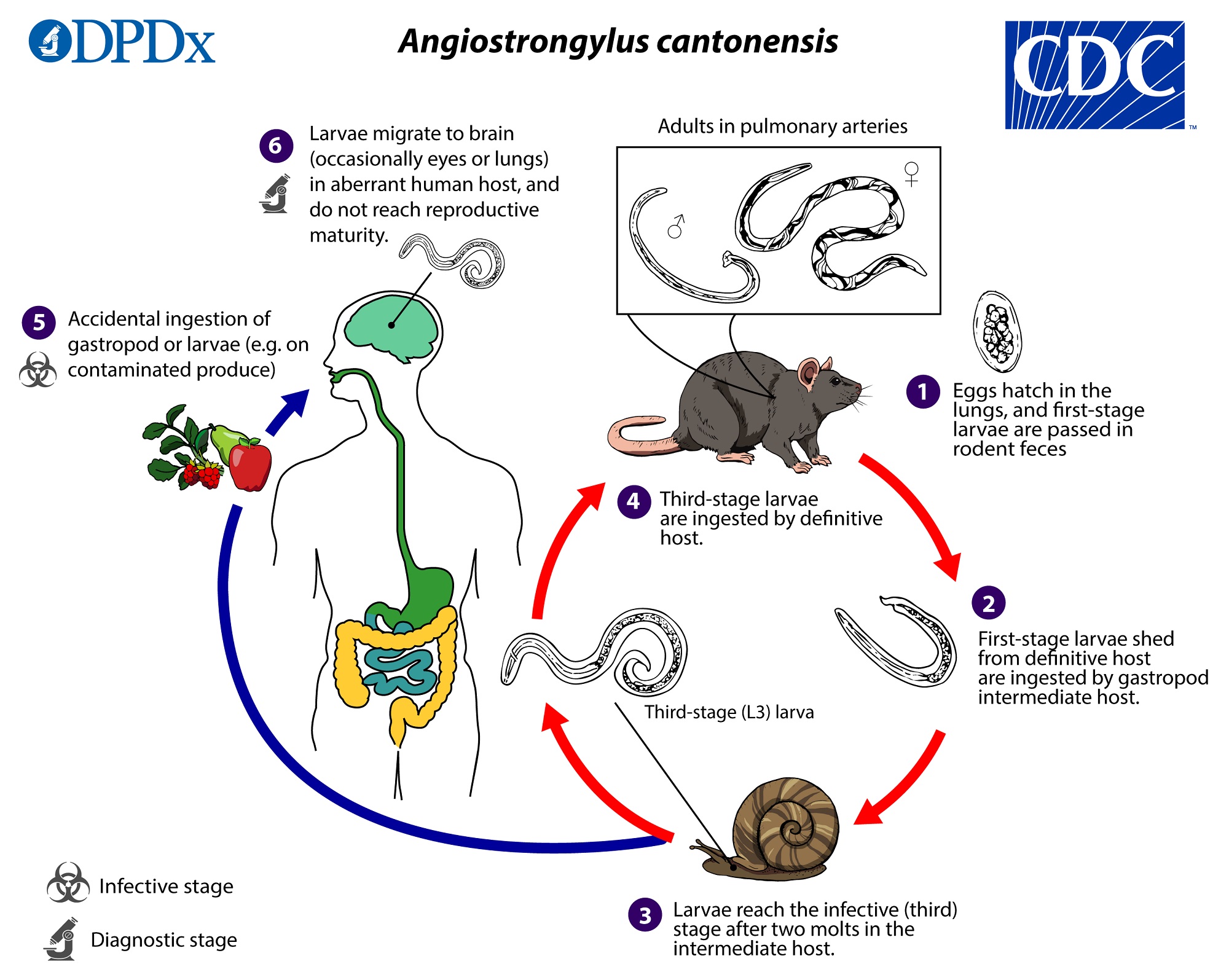 |
| The Life Cycle. |
Eosinophyllic Meningintis is a serious disease that is seldom diagnosed because it is difficult to detect. Physicians working in Chuuk, for example, when I interviewed them in 1987 or 1988, did not know about this worm. When I mentioned "Angiostrongylus cantonensis" to a physician at CHuuk Hospital who had a bachelor's degree in Parasitology, he thought I was referring to Strongyloides, the whip worm, a common intestinal disease in the islands. This physician was well trained, and deeply engaged in his work: he took the initiative of personally performing the microscopical observations of fecal samples for Ova and Parasites (O&P); yet he did not know this worm that is well documented in the islands.
 |
| From Alicata 1991 with carriers. |
Elmer Noble was a co-author of the textbook for the Parasitology course I was enrolled in, at UCSB, in 1984. Dr. Noble visited our campus, where I think he previously had taught, and presented a guest lecture. He warned us that physicians he had met during his travels in Asia were not well trained concerning parasites. He often diagnosed persons whose parasitic infections had been overlooked in routine hospital exams, for example in Japan. So it is not unsurprizing that Angiostrongylus cantonensis is not well known in Micronesia; but this is especially concerning when a book and multiple research papers had been published on this issue by an expert in the field.
 | |||
| From Alicata 1991 |
References
Alicata, J.E., 1991. The discovery of Angiostrongylus cantonensis as a cause of human eosinophilic meningitis. Parasitology Today, 7(6), pp.151-153.
Alicata, J.E., 1965. Biology and distribution of the rat lungworm,
Angiostrongylus cantonensis, and its relationship to eosinophilic
meningoencephalitis and other neurological disorders of man and animals.
Advances in parasitology, 3, pp.223-248.
Yeung, N.W., Hayes, K.A. and Cowie, R.H., 2013. Effects of washing
produce contaminated with the snail and slug hosts of Angiostrongylus
cantonensis with three common household solutions. Hawai'i Journal of Medicine & Public Health, 72(6 Suppl 2), p.83.
Great news! Reports of publically funded research should be freely available to everyone.
As outlined in this article on Slashdot, the current United States Administration has taken another step in improving the lot of mankind. A breath of fresh air in a time of chaos, when the world has been going wrong.
Wonderful.
The actual web page linked by the above article is here:
In brief:
All members of the American public should be able to take part in every part of the scientific enterprise—leading, participating in, accessing, and benefitting from taxpayer-funded scientific research. That is, all communities should be able to take part in America’s scientific possibilities.
Subscribe to:
Posts (Atom)