[I starting writing this post several years ago in a separate blog. Ellis is a favorite of the naturalists. This deserves to be re-written. For now, just some editing changes.]
John Ellis was a student of Zoophytes, literally "animal plants." Why did he consider Halimeda spp., calcifying green algae to be animals? This deserves some investigation. John Ellis deserves to be taken seriously on several accounts. He is memorialized in the "Ellis-type microscope" bearing his name. This kind of microscope---also known as a "simple microscope"---is considered a botanical microscope, as well as an aquatic microscope. The aquatic microscope figures prominently in early marine (and freshwater) zoological studies. The glass stage can be either a concave shallow dish similar to a watch glass, or a flat glass plate, appropriate to whatever specimen is under observation. Minute hydroids or bryozoans, for example, were investigated in this manner. The clip can hold a specimen apart from the stage.
These microscopes were important to many early zoologists. . Ellis was a Zoophytologist. We now understand that the hybrid nature of zoophytes derives from it's existence as a "holobiont," a single organism that is a fusion of two symbiotic species that live in a cooperative arrangement, each benefiting from the other. Another example, perhaps more familiar to some, is the lichen. This organism exists as an obligatory fusion of an alga and a fungus; neither can live in isolation from the other.
Zoophytes behaved like plants, in that they were attached and immovable, in many cases. Corals, one of the most important groups of these, live only in shallow water, where sunlight can support photosynthesis. Yet they exhibit intentional movement, like the animals they are. Such organisms we now call "holobionts," partnerships living a mutually beneficial relationship. Often, such as in the case of corals, this partnership is "obligate: neither partner can carry out all functions to support life. On coral reefs such relationships are common.
Zooxanthellae are dinoflagellates that live within corals, sea anemones, and upside-down jellyfishes. These dinoflagellates employ subsidiary pigments, Xanthophylls in partnership with Chlorophyll.
Back to Ellis. As I have recently learned, it was Ellis who originally described and named Halimeda spp. as Corallina. Corallina opuntia, one of those species, is now called Halimeda opuntia, a common algae around coral reefs in Micronesia. Wikimedia exhibits a copy of a plate from Ellis and Solander's publication in which Corallina spp. are described:
 |
| From Ellis and Solander ... |
The Ellis-Type Aquatic Microscope
At https://microscope-antiques.com/ellis.html this scope is dated c.1765, identified as a "Trembley-Ellis Type Aquatic Microscope." Trembley is remembered for his extensive studies of Hydra. It may well be that this aquatic microscope was designed by him, at least in part, for study of Hydra. One species of hydra is a holobiont, living in partnership with a single celled green algae.
Such microscopes as these are "simple microscopes." A concave glass---similar to a watchglass, serves as a stage, when viewing minute aquatic organisms.
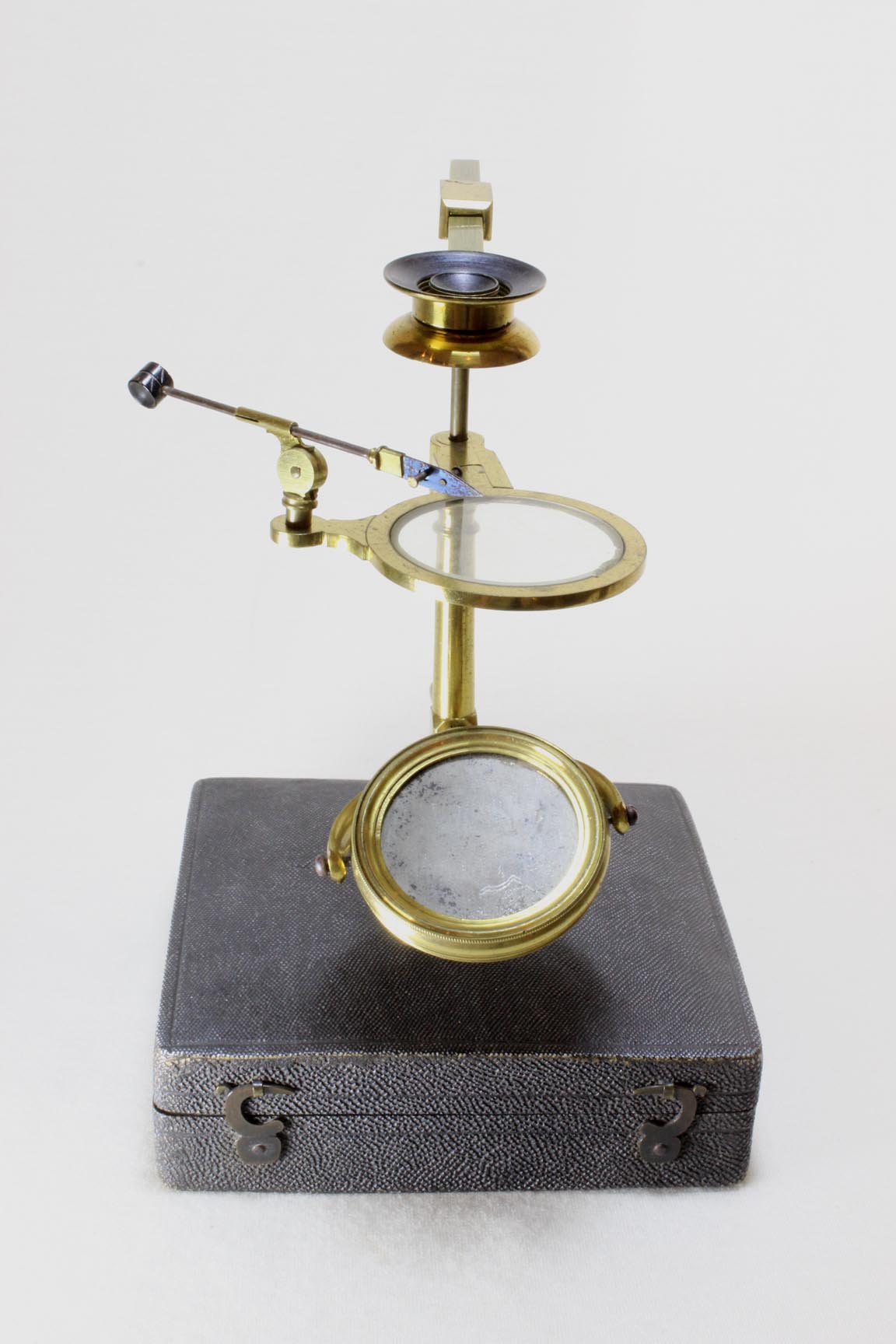 | ||
Image from https://microscope-antiques.com/ellis.html
Unlike our "compound microscopes," which have two or more lenses, simple microscopes have a single lens organized on a mechanism enabling the focusing of moving organisms on the stage, or in the watchglass. The lens can be focused vertically, and swung from side to side to follow movement or search for interesting features. |

No comments:
Post a Comment