Friday, November 20, 2026

The Naturalists' Microscopes: William Dunlop Brackenridge (U.S. Exploring Expedition (Wilkes)

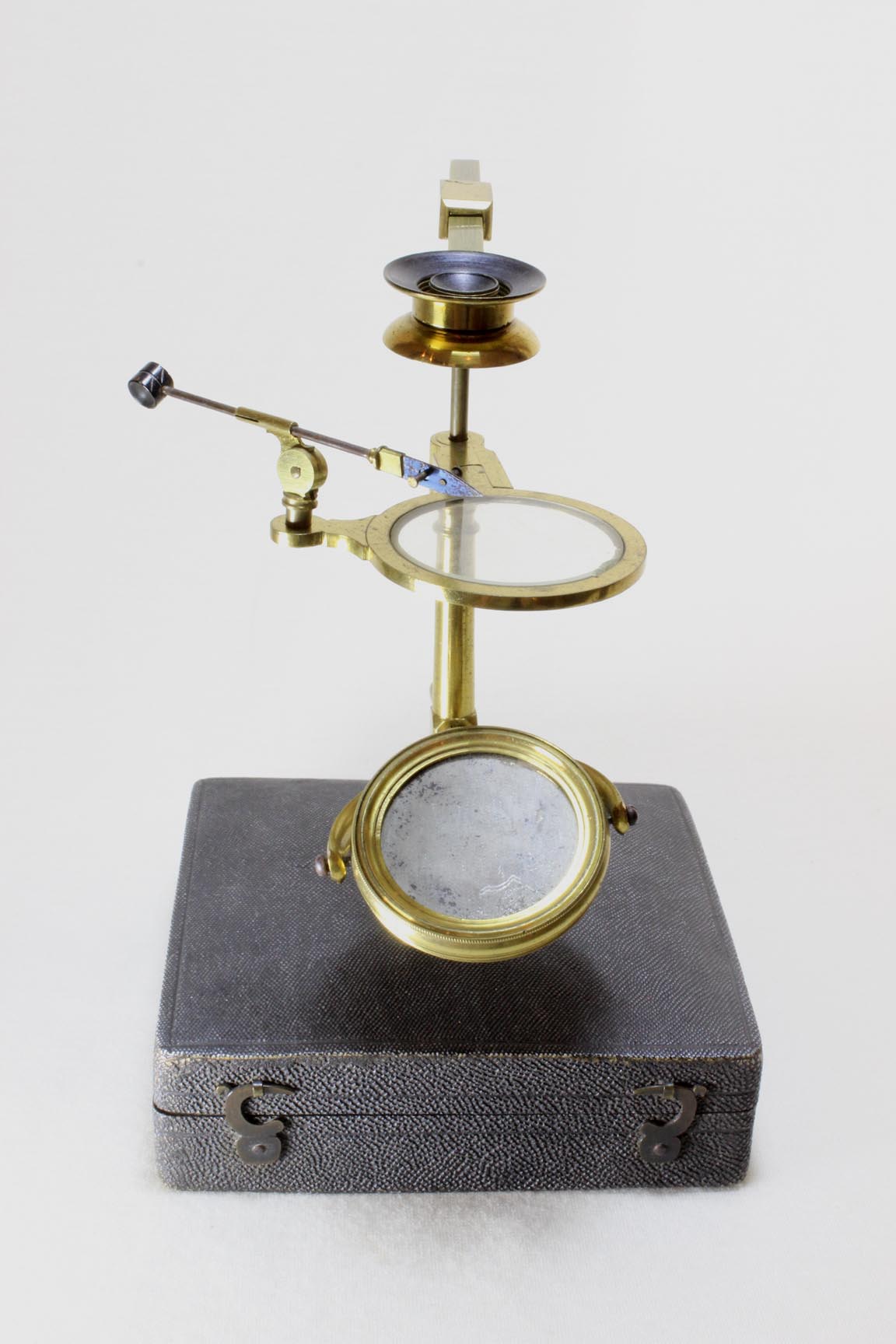
 A collector of military material posted about the microscope of Brackenridge, botanist oboard the U.S.S. Vincennes, a drum microscope.  

"While searching a popular online auction site, a rather ordinary, non-military item showed up in the search results of one of my automated inquiries. The piece, a wood-cased field microscope from 1830-1840, bore an inscription that connected it to the assistant botanist of the United States Exploring Expedition, William Dunlop Brackenridge." 


I have copied some images from the web page:


https://veteranscollection.org/wp-content/uploads/2013/04/william_dunlop_brackenridge_young.jpg
William Dunlop Brackenridge


https://veteranscollection.org/wp-content/uploads/2013/04/william-d-brackenridge-microscope-box.jpg
Dated 1840.


https://veteranscollection.org/wp-content/uploads/2013/04/brackenridge-microscope-and-box.jpg


https://veteranscollection.org/wp-content/uploads/2013/04/brackenridge-field-microscope.jpg
Original caption: "The microscope sets securely into the accompanying wooden box (source: eBay image)."


Friday, September 4, 2026

The Naturalists: Hilbrandt Boschma and Niko Tinbergen

 Hilbrand Boschma - Wikipedia


Hilbrandt Boschma's work revising the taxonomy of the Milleporids is a monument to his painstaking study of the morphological species specific characters.  


The link above directs to a wikipedia page that presents a general biographical picture of his career.   As one may see from a casual reading of this Wikipedia entry, Boschma's career went far beyond the painstaking work of revision of the taxonomy of Millepora spp.   


Lu Eldredge, a professor of mine at the University of Guam,  told of Boschma hiding in between shelves at the Rijksmuseum at Leiden, from the Nazi's during the occupation of  The Netherlands.  Due to my interest in the Holocaust---born during my formative years, as I read Mein Kampf and the stories of the exodus from Germany to Israel---this story of Boschma's trials and tribulations has remained with.  I recently Googled for more information about his life, and ultimately stumbled upon the accounts in Wikipedia.

 His role at the Rijksmuseum  was far more crucial than his zoological work might suggest.  He was, at some point during the occupation, director of the museum.  Important in my mind was to learn he had saved the scientific instruments in the institution, concealing them---apparently in a manner similar to the way, as I had I heard from Professor Eldredge, he hid his person from the Nazis.  

 I wonder how, as director of the Museum he could have kept himself concealed during those years.   

A PDF of his Eulogy is located here, in Dutch:

 https://dwc.knaw.nl/DL/levensberichten/PE00004104.pdf


I ran this pdf through Google Translate, by way of a convoluted sequence of processes: running an OCR on the dutch pdf via gscan2pdf, saving the German text file, opening this on Google Docs,  and finally using Google Translate.  The next step would be to use LaTeX to clean up the translation, format and typset; however, I skipped it in this instance.    It would probably be faster and easier on Apple Infrastructure, but freedom from the numerous encumbrances of that approach is worth the learning curve and effort, using the wonderful tools of GNU/Linux.  

The English machine translated version is long.  It is appended temporarily at the end of this post.  (Perhaps I will link to a pdf at some point, depending on space available, should I finally clean it up).  


Niko Tinbergen


An excerpt from a paper about Tinbergen is of great interest; it provides context, as well as insight into Niko Tinbergen, his work, and his trials and tribulations.  Freedom fighting scientists: perhaps a lesson for our time.


World War II. In May 1940 the Netherlands were overrun by the German forces. In 1941 most of the teaching staff of Leiden University resigned in protest against the treatment of their Jewish colleagues, and in 1942 many of them, including Tinbergen as well as many other of the most prominent figures in Dutch society (professors, cabinet ministers), were taken hostage by the Germans. They were to be the subject for reprisals after actions by the Dutch underground; in the end, some twenty of them were shot. The hostages were interned in a former training college for priests in Sint-Michielsgestel in the south of Holland.

Tinbergen was to spend two years in the hostage camp, in reasonable comfort but with the threat hanging over him. The inmates organized lectures, plays, and concerts, and there was considerable intellectual activity as well as political discussion. Tinbergen was able to write. One product of that time was a text in Dutch, Inleiding tot de diersociologre (Introduction to Animal sociology), published as a 184-page paperback after the war, in 1946. It was visually appealing, with many of his drawings, but it was never much of a success, having been written in a rather schoolmasterly style. There was a kaleidoscope of social behavior, with several arguments about behavior organization as in his previous publications. As an interesting kind of throwback, in places Tinbergen insisted that animals behave for the good of the species. Given the context in which it was written, it was not surprising that the author was not in top form. Another result of his hostage camp efforts was a series of handwritten and richly illustrated booklets about animals, for his children at home. Two of these were later published in English: Kleew (1947), about gulls, and The Tale of John Stickle(1954), about the behavior of sticklebacks.

After Tinbergen was finally released from the hostage camp in September 1944, he would spend seven more months under the German occupation, living with his family close to his field study sites near Hulshorst. Life in Leiden was too difficult in that period, known as the “hunger winter,” with serious shortages. 


The Naturalists: Sidney Hickson, a bold (and often wrong) authority

 [Here will be an account of some of Hickson's errors of interpretation.  He was an authority, often cited, often wrong.  A WORK IN :PROGRESS]


The Fantastical Life Cycle of Millepora was wrong 

Hickson was wrong about the nature of the life cycle of Millepora.  He presented a figure of insipient stages of male and female gametes, with absolute certainty...and absolute falsity.  Later, he admitted to the error.


The Ultimate Lumper

 Hickson argued that all species of genus Millepora were ecomorphs, and synonymized every one with Millepora alcicornis, a caribbean species.  Later, during WWII, Hulbrandt Boschma hid from the Nazis in Holland, in the archives of the Reichsmuseum in Leiden, while he painstakingly split this mass into substantially the same complex of species we know today.


The Naturalists: John Ellis, an eclectic naturalist and microscopist

[I starting writing this post several years ago in a separate blog.  Ellis is a favorite of the naturalists.  This deserves to be re-written.  For now, just some editing changes.] 

John Ellis was a student of Zoophytes, literally "animal plants."  Why did he consider Halimeda spp., calcifying green algae to be animals? This deserves some investigation. John Ellis deserves to be taken seriously on several accounts.  He is memorialized in the  "Ellis-type microscope" bearing his name.  This kind of microscope---also known as a "simple microscope"---is considered a botanical microscope, as well as an aquatic microscope.   The aquatic microscope figures prominently in early marine (and freshwater) zoological studies.  The glass stage can be either a concave shallow dish similar to a watch glass, or a flat glass plate, appropriate to whatever specimen is under observation.  Minute hydroids or bryozoans, for example, were investigated in this manner.   The clip can hold a specimen apart from the stage.  


These microscopes were important to many early zoologists. . Ellis was a Zoophytologist.  We now understand that the hybrid nature of zoophytes derives from it's existence as a "holobiont," a single organism that is a fusion of two symbiotic species that live in a cooperative arrangement, each benefiting from the other.  Another example, perhaps more familiar to some, is the lichen.  This organism exists as an obligatory fusion of an alga and a fungus; neither can live in isolation from the other.   


Zoophytes behaved like plants, in that they were attached and immovable, in many cases.   Corals, one of the most important groups of these, live only in shallow water, where sunlight can support photosynthesis.  Yet they exhibit intentional movement, like the animals they are.  Such organisms we now call  "holobionts,"  partnerships living a mutually beneficial relationship.  Often, such as in the case of corals, this partnership is "obligate: neither partner can carry out all functions to support life.   On coral reefs such relationships are common.   

 Zooxanthellae are dinoflagellates that live within corals, sea anemones, and upside-down jellyfishes.  These dinoflagellates employ subsidiary pigments, Xanthophylls in partnership with Chlorophyll.   

 Back to Ellis.  As I have recently learned, it was Ellis who originally described and named Halimeda spp. as Corallina.  Corallina opuntia, one of those species, is now called Halimeda opuntia, a common algae around coral reefs in Micronesia.    Wikimedia exhibits a copy of a plate from Ellis and Solander's publication in which Corallina spp. are described:


From Ellis and Solander ...

The Ellis-Type Aquatic Microscope

At https://microscope-antiques.com/ellis.html this scope is dated c.1765,  identified as a "Trembley-Ellis Type Aquatic Microscope."  Trembley is remembered for his extensive studies of Hydra.  It may well be that this aquatic microscope was designed by him, at least in part, for study of  Hydra.  One species of hydra is a holobiont, living in partnership with a single celled green algae.   
 
Such microscopes as these are "simple microscopes."   A concave glass---similar to a watchglass, serves as a stage, when viewing minute aquatic organisms.  

Ellis Aq microscope

Image from https://microscope-antiques.com/ellis.html


Unlike our "compound microscopes," which have two or more lenses, simple microscopes have a single lens organized on a mechanism enabling the focusing of moving organisms on the stage, or in the watchglass.  The lens can be focused vertically, and swung from side to side to follow movement or search for interesting features.   


Wednesday, July 22, 2026

Protein diagrams

[Work in progress] 


 I am an aficionado of proteins.  I am made of proteins.  An undergraduate course in Biochemistry opened my eyes to the simplicity and wonder of the grand "central dogma" of biology: proteins do all the work; DNA is the blueprints for proteins.   Four classes of "macro molecules" (giant molecules, made of smaller modules that are, in most cases, molecules themselves) are the building materials (so to speak) from which living organisms are constructed.  The pattern is the same for every kingdom (or domain) of life: plants, bacteria, protozoa, animals, fungi---all are systems of these four kinds of macromolecules operating through similar or identical principles.  Early on, it occurred to me at the time that macromolecules are pretty easy to understand; I wonder whether my students have found this to be the case.  Did my approach succeed?   Did it fail miserably?    


Macromolecules of three of the four kinds are chain polymers, snapped together like "pop-beads" or perhaps one-dimensional legos.  Wonder of wonders!   Proteins and Nucleic Acids (DNA and RNA) are never branched; some carbohydrates are branched, or form interconnected chains and sheets.  The  entirety of living  existence and functions is based upon the motif of linear sequences.  

 Atoms 

Many of my students did not come pre-supplied with the knowledge of   existence of atoms as the building blocks of molecules.  This foundational perspective must be explained.  I told the story of how, one day, my mother told me to look around me: everything my eyes could see, she told me, was made of a small number of kinds of atoms.  This made a big impression on me.  I now had this background knowledge; but most of my students had not.  

The organization of a living thing begins with atoms.  We can think of them as particles.  (Greek philosophers proposed that all matter is made of particles; they used the word "atom" without understanding what they are.  

 Molecules

Molecules are bunches of atoms organized in a particular way.  


The Water Molecule 

Water is H2O.  Two hydrogen and one oxygen atoms in a precise structure. This structure may be represented in various ways, or "models" including the three represented here:


Labelled Diagram


Ball and Stick Model


Space Filling Model


Macromolecules 

Macromolecules are groups of molecules.  For Proteins, Carbohydrates, and Nucleic Acids, we may refer to Subunits, the molecules that connect together to form supermolecules.  

 Think of a string of beads without a string.  Biological macromolecules are organized in the same way, especially Proteins and Nucleic Acids (DNA and RNA).  Carbohydrates are as well, but the strings can cross link.   Lipids, the remaining type of Macromolecule---fats, oils, and waxes---are not organized in this way.  I think it is remarkable that life itself demonstrates this kind of organization at the core.  

 Individual molecules, the subunits, can bond into chains.  Subunits of carbohydrates are sugars.  Strings of these sugars---mainly starches---are assembled without regard to order.  We will not concern here with carbohydrates.  Their main function is as energy sources, or for energy storage.  

In both Proteins and Nucleic Acids, particular subunits are assembled in a particular order.  Critically, the order of these subunits defines the functions.  

 Nucleic Acids primarily function as strings of coded messages.  The messages are blueprints for the order of subunits in proteins.  The blueprint for a protein is a gene.

The Subunits of proteins are Amino Acids. 

Proteins of humans and most other organisms are assembled from 20 different amino acids.  The order of these amino acids determines the function of the protein, for a particular reason: in almost every instance the function of a protein is determined by the shape into which the completed chain is folded.   A crude example is shown, from Wikipedia:

 https://upload.wikimedia.org/wikipedia/commons/c/c5/Protein_folding_schematic.png?utm_source=en.wikipedia.org&utm_campaign=imageinfo&utm_content=original

In this diagram, the filled black amino acids have hydrophobic natures---they run from water, because oil-like side chains of the amino acids flee from water.  On the right hand side, we see that this effect has helped organize the shape, into a clump.  This and other effects are responsible for the final shape of a protein, which ultimately determines the activity of the protein.     

We  begin to construct a conceptual model of a living organism as---not a mechanism, but understandable as a system, at some level---of macromolecules.  I am amazed that four general types of macromolecules make it all happen.  It had to start from the beginning,   I dare say that a few  of my students received these pieces of the puzzle enthusiastically.  

Proteins are central.  

 Life is, at some level, a system of Proteins interacting among themselves and Nucleic Acids (which carry the blueprint for their production), fueled by Carbohydrates, constrained within membranes made of Lipids (fats and oils, which also store energy and serve other functions.).  Life is, of course,  far more complicated than this; but this is the core idea.

Proteins are the prime actors.  Proteins DO everything, with few exceptions.  They are the most important structural components, and the most important actuators in all living things.   Every living organism (with a few interesting exception) is made of cells.  Proteins are the essential components of the functioning cell.  

 The following is a short list of some kinds of proteins in a living organism, from the simplest to the most complex.

  • Enzymes: catalysts of chemical reactions.  Digestive enzymes like Amylase, which breaks starch---bundles of sugars that cells cannot use as fuel---apart into into sugars, which are small, and easily imported by the cell.  Other enzymes build proteins from Amino Acid (under direction by DNA).  Enzymes repair damaged components of cells; other enzymes break down proteins that are no longer useful.  Enzymes regulate chemistry in the cell.
  • Action proteins: muscle, flagella, cilia all operate through the agency of proteins.  
  • Transport: Motor proteins carry packets of other molecules (many of them proteins) around in the cell.  Hemoglobin carries Oxygen. 
  • Antibodies function to defend cells from invasion.
  • Structural protein: hair, keratin, nails, claws, barbs and arrowheads, protective spines, the "cytoskeleton" that provides structural support to cells.  .
  • Venoms and toxins are, in many cases, proteins.
  • Proteins in cell membranes regulate the movement of materials in and out of the cell.  Some of these are critical to the operation of the nervous system.
  • Signalling proteins: 
    • Hormones (insulin, for example) secreted from cells in one organ of an organism act as messages to other organs. 
    • Neurotransmitters are proteins that, when secreted by one neuron, trigger an impulse in the next neuron.
    •  Pheromones are similar to hormones; however, these are chemical messages that, when secreted by one organism, are understand by other indivisuals.  For example,  cats mark territories (and their humans) with scents.  Female moths secrete sex pheromones, mating signals, that are recognized by males even miles away; female dogs famously signal they are in "heat" through scents that draw males in a neigborhood.  Alarm pheromones are secreted by organisms to warn of danger.  Ants mark their trails with trail pheromones.    


Protein structure determines protein function 

A protein  is a chain of one of about 20 Amino Acids in a very specific order determined by the DNA that codes for it.  Each of these Amino Acid has unique properties.  Some are charged, either + or -.  Some love water (are hydrophilic),  and others abhor water (are hydrophobic).  These and other properties of Amino Acids cause the chain to fold upon itself in certain ways.  Imagine a giant spaghetti monster made up of one extremely long strand of spaghetti, a chain of Amino Acids with different properties that cause certain links in this chain to attract or repel one another, or fold away from the water inside the cell, or to embrace it.  In the end, the strand of spaghetti folds into a precisely determined shape, it's structure.  The shape of this blob of spaghetti determines it's function.  Structure determines  function.   Imagine, perhaps, this strand of spaghetti has tiny magnets at precise locations along its length.  Some magnets are negative, and others positive.  When the spaghetti folds into a blog, the magnets help to direct specific parts of the strand to pair, or repel one another.  Some parts of the spaghetti may have tiny bits of fat precisely located along the strand, that cause the spaghetti to fold (in a water medium, like the cell) inward, away from water.  These are other forces determine the shape of a protein.   If the position of one of the magnets is changed by a tiny amount, this can alter the structure---the shape---of the resulting blob.  Such a protein would fail to function efficiently.

 Remarkably, this is exactly how it all works.  Thousands of blobs of spaghetti shaped each in it's own unique way, interact with one another.  A digestive enzyme may break starch---chains of sugars---by breaking these sugars apart.  The enzyme to break the starch chain has a pocket that precisely fits a starch molecule in a specific configuration, between two sugars, the sub-molecules of that starch chain.  The bond between these two sugars is now placed under stress and weakened, and caused to break.   If even one of the Amino Acids making up this chain were changed, say from positively charged to neutral, the shape would lose its integrity; the enzyme (amylase, in this instance) would not operate at peak efficiency., or perhaps fail to work at all.   

Each protein achieves its function through the precise ordering of its Amino Acid components, which determines the manner in which the chain folds into it's 3-dimensional structure.  DNA is a chain 4 sub-molecules, Nucleotides, in a specific order.  This order providing  the code for the Amino Acid sequence in a proteins is a gene.  


======================================= 


Today I want to look at diagrams that have been devised to help us see and understand the structures of proteins.  Structure Diagrams, .   protein is a straight chain of amino acids. 

Proteins, after all, attain every aspect of their functions from their shapes.  Their shapes are written in a linear code.  

On a visit to Lawrence Berkeley National Laboratory (LBNL) I observed a poster wrapped around a column,  touting that the shapes of over 8,000 proteins had been characterized at that facility.  


8,714 Proteins.  A Poster in the Advanced Light Source of LBNL.


Close up showing protein structure diagrams.  

The double helices are proteins!


Today I decided to dive into the  dark waters of these diagrams, that I have never understood.    I discovered something wonderful: A Wikipedia guide to proteins structure diagrams!  Put a pin in that.  I also stumbled upon an article about the LBNL Advanced Light Source, written in April 2025:

 Today, the nine structural biology beamlines at the ALS passed a major milestone of collectively depositing over 10,000 protein structures into the Protein Data Bank (PDB), a worldwide, open-access repository of protein structures. 


WOW!

Here, then, is a link to the Wikipedia Page about Ribbon Diagrams.

On this page I learned about early ribbon diagrams, hand drawn by Jane Richardson, who drew the first such diagrams by hand in 1980.   Two reproductions of her work:   

https://upload.wikimedia.org/wikipedia/commons/9/99/TriosePhosphateIsomerase_Ribbon_pastel_photo_mat.png
Triose P isomerase monomer


A Prealbumin Dimer:

https://upload.wikimedia.org/wikipedia/commons/a/af/PrealbuminDimer_ribbon.jpg

As marked, a Prealbumin dimer draw by Jane Richardson.


=================================== 

The following is different kind of model, a space filling model: an animation of Salivary Amylase breaking the bond between sugars in a starch chain.  Shown is  it's active pocket.  Starch nestles into the pocket, is broken apart by the enzyme, and is spit out in two parts.  Click in the lower right hand corner to enlarge it.  It can then be rotated using a mouse.  This is a different form of model, a space filling model.  Note the attribution.  My profound gratitude for the enormous amount of work that went into this.


`

Starch hydrolysis by amylase by svt4ever on Sketchfab


Salivary amylase is secreted by our salivary glands as seen as it detects the presence of starch, for example after eating a donut in the morning.  Right away the starch---which is a chain of sugars, albeit not a simple linear chain---begins breaking the starch down.  This process continues as the donut moves through our digestive system, by other forms of amylase.  


Proteins do it all. 


Tuesday, May 19, 2026

The Horror Story of the Ocean SUV EV: a story with a heart-warming outcome. Or, why we need more regulation.

 The company Fisker sold an SUV, the Ocean.  When they went bankrupt, they left the owners high and dry.   Owners, in can-do manner, formed a partnership and reverse engineered the code and the keyfobs, and wrote an open source replacement.  This is a great story.  It also is a terrible story.  What happened to the criminal who were let off the hook through bankruptcy.  

 The Stooges (not the three stooges) abhor regulation.  But would regulations protect the little guys from corporate outlaws like Fisker?  Here's a link to the story on Slashdot:


https://tech.slashdot.org/story/26/05/16/2318249/how-owners-of-evs-from-bankrupt-fisker-saved-their-cars-with-an-open-source-nonprofit 


Saturday, December 27, 2025

Chaos is unfolding at warp speed: profit drives us over the cliff.

 Radical new technologies assaulting the senses.  Promises of profit and even better life styles.  

 As a reminder, technologies like self-driving cars, automation, and robots, as mere examples, were designed by humans.  We do not have a good track record.  

 Unforeseen consequences are inevitable.  The human brain evolved to solve problems.  These problems were solved incrementally.  An example of incremental "progress' is science; another one is technology.  The nuclear reactor was not designed in one step.  Accidents have resulted in improvements.  But the assertion by those in Japan who say that the lessons of Fukushima have been learned fails to recognize the inability of the human brain to see the whole picture.  Other errors will inevitably creep in.  

Waymo has had to reprogram self-driving  vehicles after a power outage in San Francisco, because humans who wrote the programs did not foresee this inevitability.

 AI?  AI was designed by humans.  Is it possible for us to design something more perfect than ourselves?  


Monday, November 3, 2025

News about the Internet Archive: the cost of principled legal defense

 https://tech.slashdot.org/story/25/11/03/1930232/internet-archives-legal-fights-are-over-but-its-founder-mourns-what-was-lost


 The Internet Archive celebrated archiving its trillionth webpage last month and received congratulations from San Francisco, which declared October 22 "Internet Archive Day." Senator Alex Padilla designated the nonprofit a federal depository library. The organization currently faces no major lawsuits and no active threats to its collections. But these victories arrived after years of bruising copyright battles that forced the removal of more than 500,000 books from the Archive's Open Library. "We survived, but it wiped out the Library," founder Brewster Kahle told ArsTechnica.


Monday, September 29, 2025

Watching the ice melt? Not so much.

Since this blog doesn't  have a huge following, this is a bookmark for me.  I keep my eye on the arctic and antarctic.  The heat balance of Earth follows the difference between incoming energy---sunlight---and outgoing energy---radiation.  Greenhouse gases---Carbon Dioxide, Methane, and even water vapor, among others---block energy from leaving the planet. The more greenhouse gases, the less energy (ultimately, head) leaves the planet.  Since energy loss is less than energy income, the result is accumulation of heat.  

The specific heat of a substance is a measure of the amount of heat required to warm up 1 gram of the material by 1 degree Centigrade.  The specific heat of liquid water is 1 calorie per gram per degree C.  As the heat entering the Oceans increases, the temperature elevates, in obedience to this formula.  

 The specific heat does not reflect the amount of heat required to change the phase of, for example, water.  To evaporate one gram of water requires 540 calories of heat, with no change in temperature; this is called the heat of vaporization.   So it takes 540 times the amount of heat required to raise the temperature of a gram of water by 1 degree C,  Don't forget, no temperature change occurs during this change from water to steam.

 To melt a 1 gram ice cube requires 80 Calories.  Again, there is no change in temperature; the water just changes from a solid to a liquid phase.  This amount, 80 Calories, is called the heat of fusion.  (Removal of the same amount of heat would result in changing our gram of water to a gram of ice, again with no change of temperature.

Water has an extremely high Specific Heat.  It is partly for this reason that Earth is particularly suited for life.  On other planets, where the average temperatures are either much higher or much lower,  liquid water is not so readily available for life, for cells, for fish to swim in...   

 Our home planet fortunately dwells in the "Goldilocks Zone."   It is not too hot; not too cold; but just right.  Our ranges of temperatures, across the geography of Earth, allow the heat of fusion (melting) and vaporization (condensation) to regulate the temperatures within a limited range of temperatures that is just right.  

 Existence of polar ice provides a buffer when the incoming energy exceeds the outgoing heat.  In times when outgoing heat exceeds the incoming energy, the poles grow; our planet has experienced times of extreme cold, when ice covered a significant portion of Earth's surface.  

 Fortunately, Greenhouse Gases form a barrier that regulates, in a way, the heat loss to space.  Earth's levels of Carbon Dioxide may have been around 4,000 ppm.  More recently, those levels have stabilized; but this graph from Earth.org, a version of the "hockey stick: graph, shows those levels increasing dramatically.


Robust CO2 data from ice cores covering the last 800,000 years.


What has changed?  We can start with the Industrial Revolution, and more recently the massive scale of burning of fossil petroleum to fuel planes, trains, and automobiles, as well as to generate our electricity.  Carbon Dioxide was drawn from the atmosphere to build living systems; as living things died, they left fossils, some of them in liquid form as hydrocarbons---petroleum---that we now have been drawing to burn in service of our industrial economy.  That old Carbon, in the form of degraded biological molecules, is being returned to an inorganic, prehistoric form through our agency.  The huge increase of CO2 is Anthropogenic---generated by humans.  

 Fortunately for us, so far, the worse effects of the build-up of CO2 have been mitigated by the existence of ice at the North and South poles.  Melting of this ice absorbs a huge amount of heat; this happens without temperature change.  It is our salvation.  


Sure, earth's atmosphere and oceans are warming, but once this ice is drastically reduced, the capacity for mitigation of effects of huge heat influx will be dramatically reduced.  


This is why we watch the ice.  Irresponsible actions born of ignorance have now resulted in the loss of one of the monitors of  the arctic.  Link below.   


https://grist.org/politics/after-trump-cut-the-national-science-foundation-by-56-percent-a-venerable-arctic-research-center-closes-its-doors/

Thursday, September 25, 2025

Ocean pH status: while we deal with political distractions


https://www.theguardian.com/environment/2025/sep/24/worlds-oceans-fail-key-health-check-as-acidity-crosses-critical-threshold-for-marine-life?CMP=share_btn_url 

Tuesday, May 20, 2025

A Story: Wooden Noses

The Book __The Chinese in the Philippines_ , edited by Alphonso Felix, Jr.,  begins with stories about an early Junk trade between China and Manila.  The following story caught my attention, on page 44:


Purely by way of anecdote it is well to recall a cargo of wooden
noses that Diego de Bobadilla tells us once came to Manila. It appears
that a Spaniard lost his nose through an illness and in order to im-
prove his appearance he requested a Chinese craftsman to carve him
a wooden nose. The Chinese accomplished the task so well that the
grateful Spaniard paid him 20 pieces of silver. This led the Chinese
to believe that there was a great demand for wooden noses in Western
markets. Hence, on the coming year, a large quantity of these wooden
noses were shipped to Manila. Obviously, the cargo failed to sell.


This book interests me because trade existed between the Sultanate of Butuan (now Butuan City) and Champa, as well as China.  One group of historians suggests that Magellan's first landing site (as well as first mass) was at Butuan, on the Agusan River delta.  Several open boats were uncovered by archaeologist at this delta, dated in 4th and 11th Centuries, along with other artifacts.  These boats, known as Balanghai Boats, were open plank boats, known to have sailed to Champa.  Spanish traded for, among other commodities, beeswax and cinnamon.  An endemic species of cinnamon is Cinnamomum mindanens.  By the way, here is a photograph of, possibly, a Mindanao Cinnamon flower from this site: https://www.stuartxchange.org/Kami.html


Wednesday, December 11, 2024

A peculiar word with many meanings: scuttle

 1. A coal scuttle.

2. Walking of a crab

3. Sinking of a ship.


This word came up recently in the daily emails from Dictionary.com, but, curiously, only with the meaning relating to walking.  


to run with quick, hasty steps

          ...

More about scuttle

  • First recorded between 1450–1500.
  • Combines scud¹, meaning “to dart or run,” + frequentative suffix -le¹.
  • Sometimes associated with the locomotion of crabs.

EXAMPLES OF SCUTTLE

  • With the snorkel mask on, she could now see all sorts of creatures scuttling across the seafloor.
  • They were late for their meeting, so they had to scuttle through the crowded subway station.


It seems odd that other definitions were not mentioned.  

Monday, October 14, 2024

XKCD: Timeline of Global Temperatures, with projections

I need a new blog to keep track of Environmental Issues. This "cartoon" presents a succinct overview of Global Temperature for the last 20,000+ years. https://imgs.xkcd.com/comics/earth_temperature_timeline_2x.png

Friday, October 11, 2024

Rudimentary drift voyaging. With notes about drifting, and drift logs.

Another UPDATE:

        Second (third?) thoughts on Sir Arthur Grimble.  In Kiribati, as I was reading _A Pattern of Islands_ , I asked Mamauri, the father of my first wife Biromina, about the story of calling dolphins to the beach, and also about the giant octopus.  I was assured that the dolphin story was a true one.  I was still skeptical about the octopus hunting.  Would there really be a giant octopus in the tropics?  

Later, in some posting on the Internet, I read notes from a diver in Fiji about seeing these giant octopuses.  

 It seems ill advised to discount these accounts.  

 On a similar vein, I had heard reports, years later, of octopuses climbing trees, in Chuuk.  When I asked a specialist at the Santa Barbara Museum of Natural History about this, he said "I believe it."  I remember a friend at Santa Barbara harbor, when I was JHS age, who was catching octopus on the rocks---outside the water.  There must be a poetic saying about disbelief of what we do not directly experience.  What was that? 


UPDATE:

I think I need to come to my senses about Grimble.  He was noted by another writer to have an "overactive imagination."  Many of his writings bear the mark of veracity; but I believe a healthy dollop of skepticism is demanded of others.  In particular, the episodes in _A Pattern of Islands_ relating to fighting sharks, hunting giant octopuses, and calling dolphins need to be approached cautiously.  Not that they are impossibilities, or that they point to other, simlar examples of traditional lore.   

The story of Akurupw also seems preposterous, but is it impossible?   Who knows?  Navigators may have magic to enable survival adrift.  If anyone could survive such a drift, it would be an atoll native.   

No doubt, no matter how skeptical we might be, pacific islanders possess skills and knowledge beyond our capacity to understand or critique.


Neyret, in his Pirogues Oceanennes(1) opens his first volume ,on Australia and Melanesia, with this, as his first, most fundamental type of boat: a Tasmanian flotteur simple:


"Single (or simple) Float: It is a simple roughly trimmed shrub trunk, the big end at the front and the back finished in point, on which the swimmer rides. Thanks to the swollen shape at the front and tapered at the back, the aborigines claim that the crocodiles believe they see one of their kind swimming flush with the water, and do not come to attack him... If this is true, this mode of transport is not recommended near the mouth of the rivers, because, claim other natives (Salomonnais) sharks are very attracted to the crocodile and willingly come to snatch a steak or two. This float is in use along the north and northeast coasts of Australia.This is presented as an implement used by Aboriginal Australians as a river craft." (Translated from the French via Google Translate.)

This is an epiphany for me, connecting stories I was privy to, decades ago about the ancestor of a student of mine.  This student, whose exact name has unfortunately slipped my mine,  has a Gilbertese name (Chuukese have adopted surnames, a practice encouraged, at least in part, by the Roman Catholic church, who made it a requirement on baptism).  His ancestor is said by my son's people to have drifted---in the water---from Kiribati to Nama.  One would assume he had held onto some floating object, but I don't know whether this is the case; he was said to have been washing in the waves at the time of his discovery.   Such drifts are known to have taken place(2).  

This man, Akurupw, was said to have been festooned by barnacles and algae growing on his skin and nails when he washed ashore.  He was discovered by a local woman who was performing her morning ablutions at the beach on the windward side of the island, which is less than 1 mile long.  According to the story, the woman who discovered him married him.  Akurupw, according to islanders alive today, taught Nama islanders shark magic.  Arthur Grimble, a former district administrator of the Gilbert and Ellice Islanders at about the time of World War I, described, in A Pattern of Islands(3). a methods used to kill at least one of the most feared sharks, mako and tiger sharks, by swimmers.  This story rings of truth.

A simple float of this kind, compels the imagination, potentially filling in some blanks in the story of inter-island movements during low sea level stands, when distances between islands of the W. Pacific / Indian Ocean sphere were greatly diminished.  Such a stylized float is unknown in Kiribati, to my knowledge;  however I once was privileged to accompany a fishermen of remarkable skill at Aranuka Atoll, whose skill I have never seen surpassed who used a piece of gnarled driftwood, of roughly the dimensions of a four by four inch board, something over a meter long.  Cracks on the board served as stashes for fish hooks.  Two small sticks fastened across the board served to wind a significant length of monofilament fishing line, sufficient to reach the bottom at a depth of 20 feet or more.  A spear, made from a piece of thick iron wire was stuck into a long crack in the board, in case it was needed, with a "sling," a loop made up of inner tube from possibly a tractor tire with a length of thick monofilament into which to notch the spear.  This was towed by him across the reef platform, tied to his waist by at least 15' of home-made sennet.  A shorter length of sennet, or perhaps piece of salvaged wire, was attached along the length of the board, serving as a stringer for the many fish that he caught---some with the spear; others with the fishing line as he swam on the surface and dangled the hook in front of his quarry---in one case a grouper some 18" long.  I do not recall, but he may have been using home-made goggles carved from wood with pieces of glass from the wreck of a WWII airplane.  All in less than an hour, he caught enough fish for a large extended family gathering.  

 This fishing tale is off topic, but it illustrates how a piece of wood, even simpler in some respects---yet quite sophisticated in others---than the Tasmanian floater, can be utilized by atoll dwellers, who are absolutely tied to the sea.  In the case of Akurupw, such a float, or perhaps parts of a swamped or broken up canoe, might have served as flotation during a long drift, during which, we might imagine, he may have been able to grab a few fish or jellyfish---I have seen jellyfish cleaned and eaten on Kuria Island.

The next few items in Neyret's volume are rafts, and throughout the book, as it presents canoes from various locations in Melanesia, rafts of varying degrees of sophistication.  This simplest are just two logs lashed together.

Along as similar vein, as has been explained to me, fishermen from Nama Island are forbidden to fish on a drifting log.  Life on a 1 mile-long coral island is intimately tied to the sea; survival depends on skill in a huge variety of fishing methods.  Blue water fishermen in the west, on overpowered, oversized boats know that fish congregate around and under drifting logs.  Fish have no eyelids or irises, so  the shade under a drifting log may be be a previous resource for them.  On Nama they an extremely precious resource, so much so that it is a regulated one.  All Nama islanders belong to one of three clans.  Each clan holds proprietorship over one of three types of drift logs.  When a log is spotted, note is taken of which type, and, according to traditional practice, back on shore the chief of the clan, appropriate to the type of drift log, is notified of the spotting of a drift log.  The clan then goes into action.

Each clan has a special fish strap for its specific drift log.  I do not recall the categories of drifting logs, but I remember that one of them is cut logs that have fallen off of ships; one imagines these are also valued for lumber for canoe building.  Another is a whole tree, roots and all, with soil still attached.  It seems logical, without knowing such details, that the soil might also be prized.  I do not remember the third type of log.  

The clan members bring the trap, now, out of mothballs, so to speak.  These are said to be oversize traps, needing to be strapped onto the canoe (or canoes?).  After being transported out to the trap, an apparently highly ritualized process is involved the fishing; some living persons may know aspects of this process, and logs may even be fished today in accordance to these restrictions; however, most such fishing methods have lost at least part of the details involved, including perhaps magical incantations or formulae.  Expertise on the islands is tightly held, and these methods are probably steeped in secrecy.  Attachment of the trap to the log is such a ritualized process.  A certain member of the party is expert in swimming under the log with the rope (hand made, no doubt), with knowledge of chants and preparations.  This person, after appropriate ritualized preparations, jumps into the water, and swims under the log, chanting to himself a protective chant or prayer, for protection from the sharks that are probably nearby.

I do not know further details about this process, which was explained to me by Akitaro, the uncle of my son.  

I am interested in the calendar of natural signs (esissin) that predicts, among other things, aggregations of fishes at certain passes in atolls---for annual spawning aggregations.  For example, Eryrthina cf. variegata (paar) flowering is a signal for pelagic fishing across the Pacific.  On New Caledonia and Hawaii (for another species of Erythrina) both, it is a sign for shark hunting; elsewhere in Polynesia, for whaling season.  A man from Lamotrek Atoll,   asked "Do you know the tree that has a star?"  It was Erythrina sp.  The star is Pleiades, and they are associated, according to this man, with the time of drift logs.


--------------------

Notes

 1. Neyret, J., 1974. Pirogues océaniennes, tome 1: Mélanésie. Paris: Association des amis du Musée de la Marine (chapitre Nouvelle-Calédonie: 19-30.

2. A shorter drift, perhaps less spectacular, yet inspiring drift from Kiribati (as the Gilbert Islands are now known) to Majuro, Marshall Islands on a small boat by a young child, as I was told, who later became a medical doctor on the latter island.  

3. Grimble, A. F.  1952. A Pattern of Islands. United Kingdom: J. Murray.
Wednesday, October 9, 2024

Voting: the worst form of government except for all the rest

 When I first arrived in Micronesia, in Majuro in 1979, a project was in full motion to educate the public in the Marshall Islands about the choices they would soon face at the ballot box: Vote Aet (yes), or Vote Jab (no), on the issue of whether to join the United States in a "Compact of Free Association", or perhaps whether to join other island entities---Palau, Truk, Pohnpei, Kosrae---in a federation.  At this point, it doesn't matter which. 

The does matter, in my opinion, is how the elections---taking place across all of Micronesia---were being packaged and conducted.  What truly matters is whether the voters understood their choices.  In my opinion, despite an ongoing blitz of information at the time, and, I think, a high interest among voters, the choices were a masquerade concealing a plethora of aspects---the undiscussed (or under discussed) aspects of the bill of goods that was being sold to them. 

The educational blitz was mandated by the United Nations to ensure the voting public in the islands would be awakened to the options, as they achieved self-determination.  But it was an impossible conundrum: they could not possibly understand what has been sold them.


The same went on elsewhere.  Slogans, posters, signs, speeches, radio blitzes---radio what the only significant medium at the time---could not possibly explain what was to come.  It was, in other words, a sham.

We hold that the entire idea of democracy is wonderful;  we assume others, from other cultures, will automatically understand.     Democracy depends upon the full knowledge of the governed.  Thus, the mandate to educate the populace of these islands is critical to success; but success of what?   This election was another rotation of the drums of a steamroller, and the project to enlighten the public about the stakes at hand seemed, to my mind, a failed one.  

Just like elections in the United States, this election involved unspecified issues, and undisclosed and unpredictable consequences.  What is an election anyway?  How does this fit in with everything I have ever known?  It's fun to vote, but what does it all mean?  


============ How it is done

Than again, an election might be constructed and executed in a manner consistent with culturally historical realities.  

I was told the story of the assistant major of an island, who was a resident of a certain village, in another Micronesian entity.  This assistant mayor was a well respected man around the village,   a deacon or assistant pastor of the village church, as well as a government official in the department of education.  He made sure to be the first person to vote in an election at some point, I never knew what the election was about.  He marked his ballot openly, before the witnesses around the polling place, and openly showed how he had marked the ballot.  The voters were given the option to "open vote," or to sit before the assistant major, and mark her ballot before him; or to cast a secret ballot, marked privately in a voting booth.  

During those times, the government of the islands made available a fiberglas fishing skiff and outboard motor to each family.  I seldom if ever saw one of these fishing project skiffs used for fishing; usually they were used as transportation into town.  The fishing project was a failure, but the standard of living, I suppose, was "improved."  

As the story of the assistant mayor's influence over the vote happened, I was told that no-one who did not Although most families received fiberglass boats from the fishing project, I have been told that no-one who did not Open Vote ever did.  Boats were distributed by the Mayor's office, which also redirected road building funds for construction of a road from the dock to the Mayor's residence; this was the only road on the island at the time.  It might be argued that this greedy behavior helped to conserve the island's natural environments. 

=============


Sunday, May 19, 2024

Climate requires more attention.

 Eliot Jacobson's Climate Work

 Eliot Jacobson's Climate Blog is a worthwhile stop on the Internet Superhighway.  Prof. Jacobson first came to my notice when I stumbled upon his discussion of the debris flows in Montecito, in my home town of Santa Barbara.   As it turns out, Dr. Jacobson was formerly a professor of Mathematics and Computer Science at UCSB, my alma mater.  That was cool; but the main attraction was his graphs, representations of climate data.  As a science educator, and for personal studies of tides, I have focused a great deal of attention on graphing.  To emphasize the usefulness of graphs, I gave students pages of numbers that were at least perplexing and not easy to understand as numbers on a page alone.  Graphs bring life to these pages of numbers, and sense.  Jacobson is great at it.  

 His web page at  https://climatecasino.net/, and a more recent compendium, I Jump, are worth visiting.   

Early Bellweather of the Effect of CO2

 Fossil fuel and profit extraction corporations knew relatively early of the effects of the burning of Fossil Fuels.  Incredibly, those corporations and greedy barons continue to conceal or obfuscate the truth about Carbon Dioxide and other Greenhouse Gas emissions, taking advantage of the Supreme Court's decision that Corporations are persons, and can therefore contribute an unlimited amount to political campaigns.  I was troubled to learn of work by scientists in the employ of fossil fuel centered corporations such as Exxon and Shell, and automobile manufacturers in the late 50s, showing the dire consequences of continued use of such fuels and automobiles driven by internal combustion engines, and that these corporations continued---and to a great extent continue to this day---to build a dynasty, on a foundation of deception of the public, and denial.

Even more remarkable is this document, linked below, written by the chemist Svante Arrhenius, in 1896. This pdf is prefaced by the following description:

Arrhenius’s paper is the first to quantify the contribution of carbon
dioxide to the greenhouse effect (Sections I-IV) and to speculate about
whether variations in the atmospheric concentration of carbon dioxide
have contributed to long-term variations in climate (Section V).
Throughout this paper, Arrhenius refers to carbon dioxide as “carbonic
acid” in accordance with the convention at the time he was writing.

https://www.rsc.org/images/Arrhenius1896_tcm18-173546.pdf


Just another news item