
Thursday, March 22, 2012
Indian Coral Bean Tree in California
At the Oakland Zoo. These trees are important calendric markers throughout the Pacific. I do not know what species this tree is, in the Oakland Zoo Parking Log. See the photo in the header of this blog, from Saipan, Northern Mariana Islands.


Saving comments to the exif file of jpeg images
I am using GNU/Linux. I use several image viewing, organizing, and editing tools. Having spent hours and hours organizing my photos in one utility, for example, Gthumb, a fairly straightforward tool, with comments, these comments are stored in an invisible dot file, accessible only from that application. For years, I've wondered "How can I save these comments in a permanent manner?"
I have just made a little progress on this issue. So I will post a BRIEF description of what I have found. There is more to learn, and maybe I can get around to this another time.
There are at least two metadata standards:
Tags saved with Gwenview is only possible within Gentoo GNU/Linux when it has been compiled with certain USE flags. I won't get into this now. Also, I don't know how to go about doing this, yet, with Ubuntu or other distributions.
I finally experimented with tags today. They were apparently saved as IPTC tags, not visible in the utility "exiftags" which I think is hardwired for a standard set of tags, to allow reading and maybe manipulation of exif tags of a few types in image files, maybe to change a date, I don't know.
Another application is "jhead." With jhead, I was able to add an exif tag, "Comment", with my own comments. This tag is readable in jhead, at least. And jhead also saw the IPTC tag I stored in the same image using Gwenview.
Other programs I am using are
Here are some commands with jhead:
Here are the comments from an image I worked on today:
A more complete readout of standard exif tags is found with "exiftags". No custom or comment exif tags were seen.
I have just made a little progress on this issue. So I will post a BRIEF description of what I have found. There is more to learn, and maybe I can get around to this another time.
There are at least two metadata standards:
- Exif:
- IPTC: the International Press Telecommunications Council standard.
Tags saved with Gwenview is only possible within Gentoo GNU/Linux when it has been compiled with certain USE flags. I won't get into this now. Also, I don't know how to go about doing this, yet, with Ubuntu or other distributions.
I finally experimented with tags today. They were apparently saved as IPTC tags, not visible in the utility "exiftags" which I think is hardwired for a standard set of tags, to allow reading and maybe manipulation of exif tags of a few types in image files, maybe to change a date, I don't know.
Another application is "jhead." With jhead, I was able to add an exif tag, "Comment", with my own comments. This tag is readable in jhead, at least. And jhead also saw the IPTC tag I stored in the same image using Gwenview.
Other programs I am using are
- shotwell -- good for importing files into a date tree from an SDCard
- Picasa -- good at organizing, but has those sad volatile meta data. Unfortunately Google, written originally in GNU/Linux, has not provided native GNU/Linux ports of this. It runs on top of Wine. Not completely acceptable yet. Maybe good for uploading, if I get into that.
- gthumb
- digikam -- I will experiment, but previously had some issues. First, will it import to the same tree as shotwell? I saw a comment on the Inet that Digikam uses IPTC metadata. Interesting.
- gwenview (KDE4) -- does a lot, and because it's local (on the HDD) and is native, it is pretty attractive. It's gymnastics with tags are so far useful. Saves tags in IPTC format.
- some gnome tools?
Here are some commands with jhead:
- to add a comment:: jhead -ce <path to file>
- to read the metadata (exif and IPTC):: jhead <filename>
- to see other options:: jhead -h
Here are the comments from an image I worked on today:
~/WB/org $ jhead ~/Pictures/2012/03/22/img_0592.jpg
File name : /home/deckert/Pictures/2012/03/22/img_0592.jpg
File size : 130820 bytes
File date : 2012:03:22 08:38:06
Camera make : Canon
Camera model : Canon PowerShot SD1100 IS
Date/Time : 2012:03:22 08:38:06
Resolution : 2048 x 1536
Flash used : Yes (manual, red eye reduction mode)
Focal length : 18.6mm (35mm equivalent: 117mm)
CCD width : 5.72mm
Exposure time: 0.017 s (1/60)
Aperture : f/14.0
Focus dist. : 0.45m
ISO equiv. : 100
Whitebalance : Manual
Metering Mode: pattern
Comment : Tripod used, Crab Cove
Comment :
======= IPTC data: =======
Keywords : tripod
A more complete readout of standard exif tags is found with "exiftags". No custom or comment exif tags were seen.
~/WB/org $ exiftags ~/Pictures/2012/03/22/img_0592.jpg
Camera-Specific Properties:
Camera Model: Canon PowerShot SD1100 IS
Equipment Make: Canon
Camera Software: Picasa 3.0
Maximum Lens Aperture: f/4.9
Sensing Method: One-Chip Color Area
Lens Size: 6.20 - 18.60 mm
Firmware Version: Firmware Version 1.00
Owner Name: Alan and Fe
Image-Specific Properties:
Image Orientation: Top, Left-Hand
Horizontal Resolution: 180 dpi
Vertical Resolution: 180 dpi
Image Created: 2012:03:22 08:38:06
Exposure Time: 1/60 sec
F-Number: f/14.0
ISO Speed Rating: 100
Lens Aperture: f/14.0
Exposure Bias: 0 EV
Flash: Flash, Compulsory, Red-Eye Reduce
Focal Length: 18.60 mm
Color Space Information: sRGB
Image Width: 2048
Image Height: 1536
Rendering: Normal
Exposure Mode: Auto
Scene Capture Type: Standard
Unique Image ID: 5b5bfc656e8e1824c2814e2936491976
Focus Type: Close-Up (Macro Mode)
Metering Mode: Evaluative
Sharpness: Normal
Saturation: Normal
Contrast: Normal
Shooting Mode: Manual
Image Size: Unknown
Focus Mode: Single
Drive Mode: Single
Flash Mode: Red-Eye Reduction (On)
Compression Setting: Normal
Macro Mode: Macro
Subject Distance: 0.450 m
White Balance: Custom
Exposure Compensation: 3
Sensor ISO Speed: 160
Image Number: 100-0592
Wednesday, October 12, 2011
Mangroves in the Philippines
During my first trip to the Philippine Islands, I flew straight to Butuan CIty to join Fe and William, who had been there a few days.
Just ran across a blog post by the Philippines Field representative from Seacology, about a Seacology project at Malhaio, Cebu, Philippines: A Covenant for Malhiao’s Mangroves .
Malhaio is located on the W. Coast of Cebu, facing Badian Island. The project involves and exchange of promises: Malhaio will implement a no-take zone of 73 hectares of mangroves, while Seacology will fund the building of a boardwalk and viewing deck to support the development of tourism. Jobs are involved, for enforcing the no-take zone.
Just ran across a blog post by the Philippines Field representative from Seacology, about a Seacology project at Malhaio, Cebu, Philippines: A Covenant for Malhiao’s Mangroves .
Malhaio is located on the W. Coast of Cebu, facing Badian Island. The project involves and exchange of promises: Malhaio will implement a no-take zone of 73 hectares of mangroves, while Seacology will fund the building of a boardwalk and viewing deck to support the development of tourism. Jobs are involved, for enforcing the no-take zone.
Monday, August 1, 2011
A "Daddy Long Legs" in Texas
A close up also. This is not a spider. A wonderful blog had a discussion of these creatures.

[caption id="attachment_72" align="alignright" width="1024" caption="Phalangiid"]
 [/caption]
Monday, June 20, 2011
On a Saipan beach: Attack of the winged ants
We joined several friends at the beach yesterday afternoon. Our fun in the sun (and rain) was interrupted by a hoard of itching insects. Photographs show that they are ants.
[An email exchange over the course of a single day (June 21--coincidentally, the Summer Solstice) has led to something of an understanding about what this ant may be---or at least a general direction to look at. In the interest of accuracy, I am revising this post.]
Possibly they are Solenopsis geminata winged males. [Wrong on two points---they are not males, and they are not members of genus Solenpsis] They may belong to genus Hypoponera, and they are apparently reproductive females. An expert, Cas Vanderwoude, hasthis to say about this genus:
Their stings bothered some members of our Fathers' Day party at Paupau Beach, while others were not bitten at all.
 James Wetterer, who has taken on the task of cataloguing the ants of the Marianas, has forwarded an apparently unpublished list, with the following three members of genus Hypoponera listed:

At the site http://ipm.ncsu.edu/AG369/notes/fire_ants.html, was found some fundamentals. We had wondered whether this was a fire ant, when it was black. With red legs. The workers of Solenopsis geminata are red. Writing about S. invictus, which (hopefully) we do NOT have on Saipan, the writers of that page made the following comments on the coloration of adults of various guilds:
I'm inclined to think that is what we have here.
The latter species has been noted as an invasive tramp species, elsewhere.
Aubrey Moore has contributed further:
Leading me to be even more cautious, Google teaches that in some ants, reproductive (winged) females may be dimorphic: Solenopsis spp. have macrogyne and microgyne populations, that make nuptial flights at different times of year.
Two days later, Fe is still suffering from intense itching: when someone touches one of the swollen bites (some of which are starting to develop white heads), she reports that these bites all over her body itch intensely. Mainly, on her back, back of the neck especially, and a couple on her arms. I was also attacked, but my reptilian skin seems to protect me better: only a couple of bites have swollen up. Fe says she was wearing perfume that day: she was clearly the most seriously affected, as she sat in the water for an hour or two, writhing in discomfort. They swarmed all over the back of my (red) shirt, and some others were bitten, and in at least one case, the bites subsided within a day.
This is clearly a seasonal event, and quite probably lunar. Winged ants of another species, a carpenter ant (Camponotus cf. chloroticus) swarmed out of the sill of the front door of our apartment on the same night. They are still bothering me two days later (just like their workers do, all the time.)
[An email exchange over the course of a single day (June 21--coincidentally, the Summer Solstice) has led to something of an understanding about what this ant may be---or at least a general direction to look at. In the interest of accuracy, I am revising this post.]
Whatever it is, it’s a Ponerine. All Ponerines have painful stings – some are reluctant to use it but others are more than happy to give you a jab or 2.
Their stings bothered some members of our Fathers' Day party at Paupau Beach, while others were not bitten at all.
 James Wetterer, who has taken on the task of cataloguing the ants of the Marianas, has forwarded an apparently unpublished list, with the following three members of genus Hypoponera listed:
The red imported fire ant is the most common and troublesome species of ant in the southeastern United States. The worker (wingless female) is reddish or dark brown and may be large (6 mm) or small (3 mm). Winged males are black and have colorless to pale brown wing veins. Winged females are mostly light brown. Distinguishing among species of ants in the genus Solenopsis is difficult.
- Hypoponera confinis (Roger) Tinian, from specimens.
- Hypoponera pruinosa (Emery) Tinian and Papago, Saipan, both from specimens.
- Hypoponera punctatissima (Roger) Guam and Asuncion, from published records.
The latter species has been noted as an invasive tramp species, elsewhere.
Aubrey Moore has contributed further:
Were these ants stinging you? If so, they were females. The stinger is a modified ovipositor, so only females can sting.
Leading me to be even more cautious, Google teaches that in some ants, reproductive (winged) females may be dimorphic: Solenopsis spp. have macrogyne and microgyne populations, that make nuptial flights at different times of year.
Two days later, Fe is still suffering from intense itching: when someone touches one of the swollen bites (some of which are starting to develop white heads), she reports that these bites all over her body itch intensely. Mainly, on her back, back of the neck especially, and a couple on her arms. I was also attacked, but my reptilian skin seems to protect me better: only a couple of bites have swollen up. Fe says she was wearing perfume that day: she was clearly the most seriously affected, as she sat in the water for an hour or two, writhing in discomfort. They swarmed all over the back of my (red) shirt, and some others were bitten, and in at least one case, the bites subsided within a day.
This is clearly a seasonal event, and quite probably lunar. Winged ants of another species, a carpenter ant (Camponotus cf. chloroticus) swarmed out of the sill of the front door of our apartment on the same night. They are still bothering me two days later (just like their workers do, all the time.)
Tuesday, June 14, 2011
History of San Francisco Bay as Estuary
I've started digging around, trying to get a sense of our new home. I've lived in the Bay Area before, but never with a naturalist's eye. Now I stumble upon a consumately well written piece by none other than the great Joel Hedgepeth: San Francisco Bay: The Unsuspected Estuary, available here.
This paper, dated 1979, provides an appealing and broad coverage of the early history of naturalistic study of the Bay, and of the Bay's abuses at the hand of modern man. This goes with me on the plane. Here's one of the earlier pioneers, Grove Karl Gilbert:
[caption id="attachment_43" align="alignright" width="234" caption="From the PDF."] [/caption]
For nearly 200 years, Spanish navigators sailed the Manila galleons from Acapulco, northward past the unseen Golden Gate of San Francisco Bay, to Cape Mendocino whence they turned westward across the Pacific. It was not until 1769 that European explorers and "men of God" discovered the Bay, not from the sea by entering the Golden Gate, but from a hill to the south.
This paper, dated 1979, provides an appealing and broad coverage of the early history of naturalistic study of the Bay, and of the Bay's abuses at the hand of modern man. This goes with me on the plane. Here's one of the earlier pioneers, Grove Karl Gilbert:
[caption id="attachment_43" align="alignright" width="234" caption="From the PDF."]
 [/caption]
Sunday, April 3, 2011
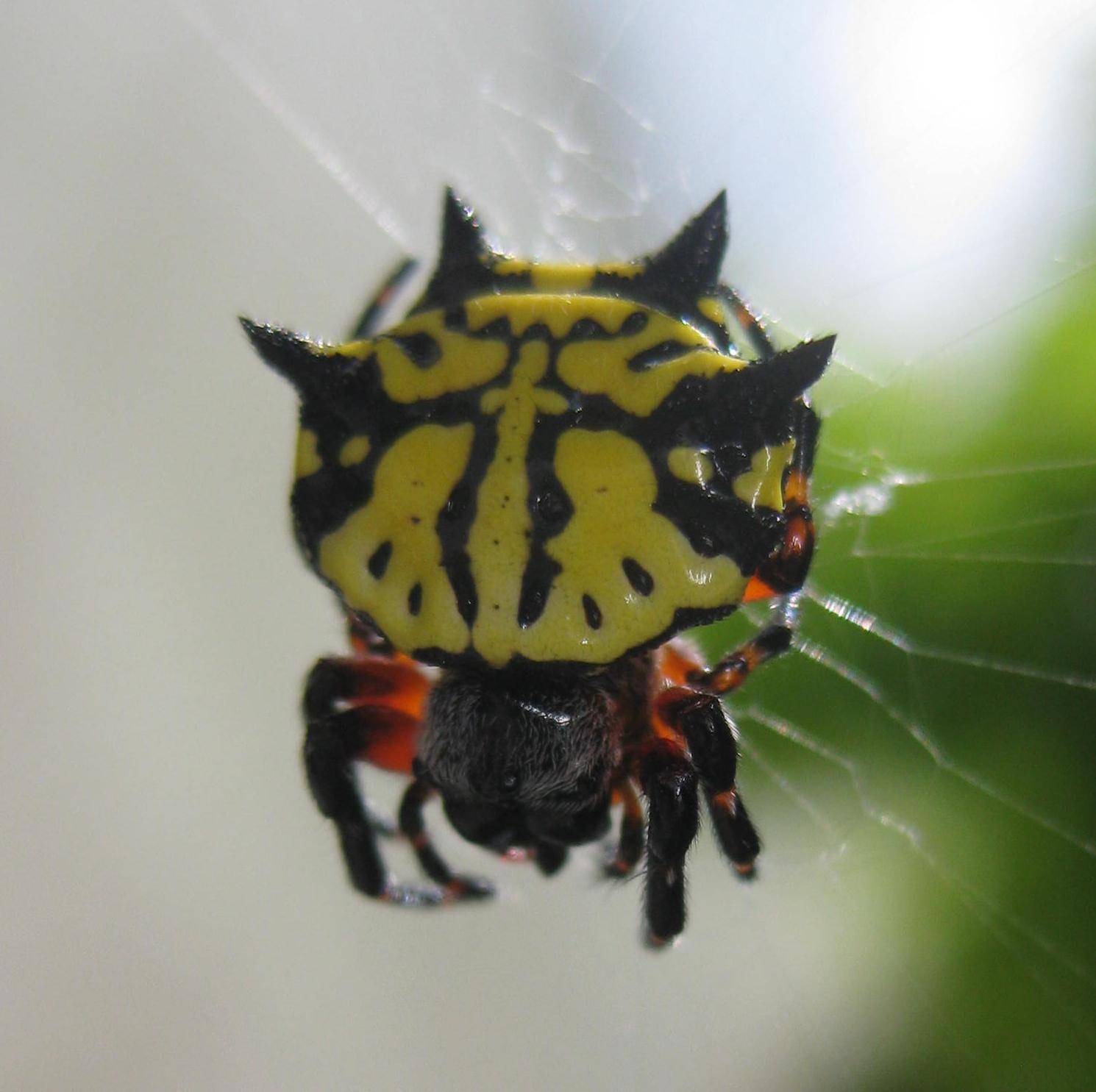
Spiders
Two lucky shots of spiders, and two cool spiders. I haven't seen the crab spider before. I'd probably have noticed, as I am enamored of the crab spiders of Hawaii.

I read something this morning about Kleptoparasite spiders. This spider resembles one of them. Doggone it! That was one of the PDFs I didn't bother to save or take notes on. I'm using a new system to take notes and save bibliographic information from Google Scholar Searches, using Org-mode, BibTeX, and Cb2bib. Should've.

It seems noteworthy that the web of the silver bodied spider (the putative kleptoparasite) was butted right up against the web of the Crab Spider.
The webs were above a clothesline outside our apartment. Taken using a Canon SD1100 IS, with CHDK hacked firmware.
I read something this morning about Kleptoparasite spiders. This spider resembles one of them. Doggone it! That was one of the PDFs I didn't bother to save or take notes on. I'm using a new system to take notes and save bibliographic information from Google Scholar Searches, using Org-mode, BibTeX, and Cb2bib. Should've.

It seems noteworthy that the web of the silver bodied spider (the putative kleptoparasite) was butted right up against the web of the Crab Spider.
The webs were above a clothesline outside our apartment. Taken using a Canon SD1100 IS, with CHDK hacked firmware.
Subscribe to:
Posts (Atom)