Tuesday, April 5, 2016

An unfufilled Wedding Gift and a remarkable reproductive strategy

We owe my Paternal Cousine, Jennifer, and her husband Emmanuel a gift that has been a long time in the coming: a mantel piece glass sponge, the Venus Flower Basket, Euplectella sp.  I promised them in a letter, those many years ago, that I would send them one of these when I found one.  I hope that this post will not win their forgiveness, but be a sign of my sincerity.  Nor do I bear this as a burden of guilt, but that is just because I do not work that way.

Skeleton of the Venus Flower Basket, Euplectella sp.
In my letter, I told Jenny and Emmanuel of the symbolism that is famously honored in Japan, of a pair of shrimp that live within this exquisitely intricate and beautiful glass prison.   For this sponge is, I am led to believe, sometimes given as a wedding gift in Japan. 


Here is a description of Euplectella sp. by Sir Charles Wyville-Thomson,  chief scientist of the Challenger Expedition, 1873-76. 

This other vase-shaped animal, half glass & half sponge is not unknown in England, but has never before been obtained elsewhere, than off the Phillipine Islands. From their great beauty and rarity they were, on their first appearance, sold in England for £50 apiece, as chimney ornaments.
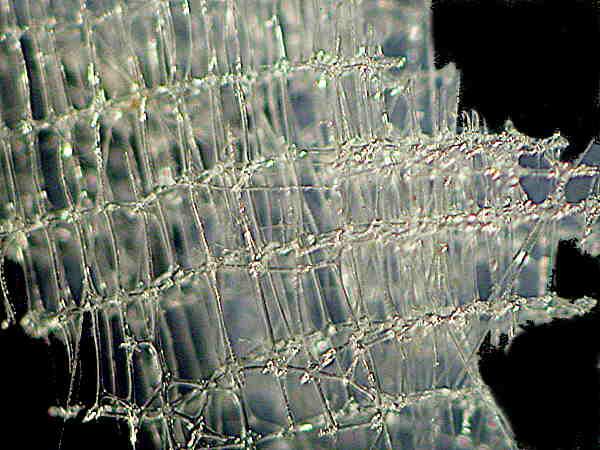

 The intricate structure of a glass sponge, made of fused Siliceous spicules.  I found a web page for amateur microscopists about Searching for Spicules.


Spongicola venustus  is a shrimp with a symbiotic relationship with Euplectella spp. 

The Love Story

In the following web page is explained that the shrimp's reproductive strategy is rational withing the sparse ecosystem of the deep sea: http://schmidtocean.org/cruise-log-post/a-deep-sea-love-story/ 

The Shrimp: Spongicola venustus 

 Saito and Komai had this to say of the group of shrimps to which this species belongs:
The symbiont spongicolid shrimps are generally characterized by a reduced armature of the body and appendages and by a rather depressed body form, representing a typical pattern of adaptation to a life in a confined space within the host animal (Bruce 1976). Furthermore, some of them show a trend toward reduction of the gills and exopods on maxillipeds


The drawing as well as the description are from
Saito, T. and Komai, T., 2008. A review of species of the genera Spongicola de Haan, 1844 and Paraspongicola de Saint Laurent & Cleva, 1981 (Crustacea, Decapoda, Stenopodidea, Spongicolidae). ZOOSYSTEMA-PARIS-, 30(1), p.87.


A remarkable series of images of the shrimp and the host sponge is found, in Korean, at the following site: http://sima-niger.net/kairodoketsu-133 .


The following image is taken from this site.


And here's the lid:


Monday, March 21, 2016

Experiments using a loupe with the camera of a mobile phone

I have had a chance to try the use of a simple loupe as a macro attachment, using blue-tac.  In particular, I used Loctitie Fun-Tak mounting putty.  The results were compelling. 


The blue mass is a blob of blue-tac.  The loupe is a relatively inexpensive one, attached by small bits of blue tac.  It was possible to work safely outside with the phoned, as the material held the lens firmly in place.  The lens was centered over the camera lens of an iPhone 6S+.  I used several different loupes.  One of them had an integrated led illuminator. 


Sound measurement using Mobile Phones.

An interesting result here.  For what it's worth.   The Peterson Strobe tuner is available for Android and Apple Phones.  Some comments online suggest that the Android version  of this app performs poorly, and my own experience with the expensive app ($10.00) is consistent with that assessment: I have experienced crashes repeatedly, and lagging.  It was somewhat dysfunctional for me, on a Samsung Galaxy S4.  I also have an iPhone version, which has seldom been used. 

For unknown reasons, iPhones have been adopted for a variety of scientific measurement applications.  The following general conclusions are drawn from an analysis of sound measurement apps on mobile devices.  Sadly (imho) Android devices did not seem to fare so well.

From Kardous, Chucri A., and Peter B. Shaw. "Evaluation of smartphone sound measurement applicationsa)." The Journal of the Acoustical Society of America 135.4 (2014): EL186-EL192.

The effect of the four different iOS devices used in this study on sound level measurements as demonstrated in Table III and Figs. 3(a) and 3(b) show that the older iPhone 3Gs model produced the best agreement for all the apps and noise levels tested (420 samples), with mean differences of 0.44 dB and −0.71 dBA between the apps and the reference microphone measurements. The variability in the results could be due to the different microphone elements in each device as Apple moved to a new supplier of microphones with the introduction of the iPhone 5 and iPAD 4th Generation devices. The differences could also be related to the introduction of a new operating system (iOS 6) that allowed developers to bypass speech filters and input gain control on older devices.

Almost all smartphone manufacturers use microelectromechanical systems (MEMS) microphones in their devices. MEMS microphones typically have a sensitivity between 5 and 17.8 mV/Pa and can capture signals as low as 30 dB SPL and as high as 120 to 130 dB SPL (signal-to-noise ratio >60 dB). MEMS microphones also have a flat frequency response similar to ceramic and condenser microphones used in type 2 noise dosimeters. With the introduction of the iOS 6 operating system in late 2012, Apple allowed developers to bypass the high-pass filter that degraded the quality of acoustical measurements on older iPhones. This development also allows users of Apple smartphones to connect external microphones through the headset input jack. External microphones such as the MicW i436 (Beijing, China) Omni-directional measurement microphone comply with IEC 61672 class 2 sound level meter standard. An extension of this study is planned to examine the effect of external microphones on the overall accuracy of sound measurements apps.

The Android-based apps did not have features and functionality similar to the iOS apps. This is likely due to the development ecosystem of the Android marketplace and users' expectations for free or low priced apps. A comprehensive testing procedure could not be carried out to show conclusive evidence of differences, since not all apps shared features and metrics that met our selection criteria. The limited testing showed a wide variance between the same app measurements on different devices. This can likely be attributed to the fact that Android devices are built by several different manufacturers and that there is a lack of conformity for using similar microphones and other audio components in their devices.

Thursday, March 10, 2016

A useful macro attachment for a phone

Simplicity.

Blue Tac + hand lens = Macro attachment.

This opens up some possibilities. Is this self explanatory?  Center the lens over the cell phone camera.  Shoot. 


Above is a photo of the Lightning connector of an iPhone. Did you know that the reason this is so expensive is that Apple has incorporated a chip to change pinouts based on which way this either-way connector is plugged in? Below is a photo of the lens with blue-tac.

Tuesday, January 19, 2016

Check this out: important early archaeology in the Philippines

Some amazing dates and places.  The Butuan Boats I have seen.  The argument still rages on: Where did Magellan really land?  At least three authoritative answers are to be seen.

Just this one link for today: 
15 Most Intense Archaeological Discoveries in Philippine History

Monday, January 11, 2016

Cloud Types

This is a good link.  There are undoubtedly dozens of others.  This one looks and feels right.

http://www.metoffice.gov.uk/learning/clouds

Back in the day I was wont to while away the mornings at the Weather Station on Moen, Chuuk, especially during the daily baloon launches.  These launches were coordinated throughout the Pacific, in a project of tne Weather Service.  I remember seeing the word "teleconnections," referring to interactions between atmosphere and ocean.  I'm, sure El Nino came into play.  And a device in a small protective closet (like those around the weather instruments at airports---this weather station was at the Chuuk Airport) that pumped air through a cannister for later analysis to detect isotope signatures from radiation blown around the Earth from Chernobyl, as I believe I recall.

And at this weather station I found a book, among several fascinating books, published by the UK Meteorological Office, an atlas of cloud types.  This was an amazingly unique and beautiful book, bound in plastic covers---so as to be water resistant---with extremely high quality photographs, and remarkably beautiful and apt photographs of each type of cloud.  The best I have seen.  I have searched over the years, and found nothing to equal it.

The observers at the Chuuk Weather Station took cloud observations, I think, hourly. 

I am not surprized then that the Meteorological Office would have a web site of this nature.

This is one for the list of links.  Every young man or young woman, of any age, would do well to have a gander at this site.

Fe asked "what is cloud nine?"  Here's what I found out from the Wiktionary:

Popular etymology references the 1896 edition of the International Cloud Atlas which defined ten types of cloud. The book defined the ninth cloud as the cumulonimbus, which rises to 10 km (6.2 miles), the highest a cloud can be. No conclusive evidence, however, confirms this origin.
This web site, the catalog of clouds, identifies Cumulonimbus as a low level cloud.  ?????

Another page on the same site references the cloud spotting guide:

Met Office guide to cloud types and pronunciations

Source: metoffice.gov.uk

On the same site may be found a link to a pdf of Cloud Types for Observers.  Could this be a later iteration of the same book I saw in the Chuuk Observatory?

[This  post bears no connection with the film or recent novel Cloud Atlas, which, nevertheless I would like to see.]