Reamur applied the term "Polyp" to Hydra that were sent to him by mail by Abraham Trembley. He determined that these polyps, of Hydra spp., are animals. Polyp referred to Cephalopods; hydra was deemed to resemble and octopus or squid.
The following is a note from Trembley regarding these issues:
https://www.evernote.com/shard/s98/sh/dd2fb6c1-045e-4ac7-9f0a-2da293787b0b/b2dfe04b4a072746e26af6cb571316c3
[ NOTE: The term "polyp" was discussed by Reaumur; however, it was not his original idea, but that, I believe, of Peysonnel. More later.]
Thursday, October 13, 2016

Friday, September 9, 2016
cb2Bib Reference and PDF Management
I've been a fan of cb2Bb for years. It's a magical application (not an App!) for quickly processing a BibTeX entry for any bibliographic reference. A quick note about a feature I've only recently discovered---as recent as today: extracting of a BibTeX reference from a PDF file itself.
What remains is to tweak the script "bib2pdf" that is part of this package, to include annotations in the printed PDF. I've done it, but it's enough of a hassle that I don't wish to go through the process again. Mainly, I need to understand BibTeX better.
I processed a folder full of PDFs in about 2 minutes into a PDF listing. Quality was an issue. Again, no annotations and no abstracts. This is doable. Certainly it is a time saver.
This program works on Windoze and I have had it installed, but with lousy results on a mac.
What remains is to tweak the script "bib2pdf" that is part of this package, to include annotations in the printed PDF. I've done it, but it's enough of a hassle that I don't wish to go through the process again. Mainly, I need to understand BibTeX better.
I processed a folder full of PDFs in about 2 minutes into a PDF listing. Quality was an issue. Again, no annotations and no abstracts. This is doable. Certainly it is a time saver.
This program works on Windoze and I have had it installed, but with lousy results on a mac.
Tuesday, August 30, 2016
Ricoh WG-5: A Mixed Review: Part I
[UPDATE: This camera was defective. I am returning it to Beach Camera for a refund, after Ricoh customer service suggested it is defective. I have elected not to exchange it. The quality issue is serious enough to scare me away. I may change my mind. For less money, I might go for a clip-on macro lens for the iPhone 6S+, except it's already been rendered obsolete by the iPhone 7---and how would you clip a supplementary lense on a dual camera phone?]
I've gotten ahold of a Ricoh WG-5 GPS camera, with Digital Microscope Mode that I have salivated over for some long time. I was mightily disappointed at first, and, to be sure, the quality of the images has not much improved with experimentation. However, I have had some limited success with Microscope Mode that suggests this camera, in some way, will be a boon. If nothing more---and there is, fortunately, quite a bit more---this camera proves that manufacturers could be making much more useful instruments for macro photography---especially in focusing super close without attachments, and designing lighting to the task. Let us hope that in the future, some manufacturers will perfect this approach.
It's somewhat mysterious what this microscope mode is, and what it can and cannot do, which led to my vacilation about taking this seriously. Perhaps I can clear the air a little if I can start to post some notes and photos.
The manual helps only a little with Microscope Mode, although for this camera, I actually have found it helpful to read the manual. This camera has many features that are not intuitively obvious.
I have had my eye on the tough cameras for a long time, and finally got ahold of one. Here's the first hard-learned bit: the models of two years ago (WG-3) are almost identical in terms of functionality, so one can save some money.
 This fragile little ring is a clue to a certain goodness of this camera: the ability to take a photograph of an object flush on the table top. Here are three full-frame shots taken using the Macro Stand, with the ring of LEDs around the perimeter of the lens.


 These are Millimeters on a small machined rule.
It is helpful to hold the object steady.
Full view taken with Macro Mode
Notice the six LEDs reflected from the glass slide in this view, taken with the camera elevated.
 Resting on the Macro Stand. A reflective white table top was fortuitous. I used "Vivid" mode to enhance the colors.
Closer up still, zooming in:

I've gotten ahold of a Ricoh WG-5 GPS camera, with Digital Microscope Mode that I have salivated over for some long time. I was mightily disappointed at first, and, to be sure, the quality of the images has not much improved with experimentation. However, I have had some limited success with Microscope Mode that suggests this camera, in some way, will be a boon. If nothing more---and there is, fortunately, quite a bit more---this camera proves that manufacturers could be making much more useful instruments for macro photography---especially in focusing super close without attachments, and designing lighting to the task. Let us hope that in the future, some manufacturers will perfect this approach.
It's somewhat mysterious what this microscope mode is, and what it can and cannot do, which led to my vacilation about taking this seriously. Perhaps I can clear the air a little if I can start to post some notes and photos.
The manual helps only a little with Microscope Mode, although for this camera, I actually have found it helpful to read the manual. This camera has many features that are not intuitively obvious.
I have had my eye on the tough cameras for a long time, and finally got ahold of one. Here's the first hard-learned bit: the models of two years ago (WG-3) are almost identical in terms of functionality, so one can save some money.
The Macro Stand.
Together with the camera is a microscope stand ring that snaps to the front of the lens.


It is helpful to hold the object steady.
Case in Point: Cataloging Microscope Slides
Here is a something more useful. |
| Full View (Macro Mode) |
Notice the six LEDs reflected from the glass slide in this view, taken with the camera elevated.
 | ||

Closer up still, zooming in:

Bottom line: Not publishable, but very useful. Truly a legitimate use.
Lighting.
I haven't yet mastered the use of the macro modes or the macro LED light ring. They can be set up to be on for macro focusing. Nice for night shooting outside. They seemingly brighten for a flash of time during exposure. The strobe flash is separate. The ring lights are the obvious Coup of this camera. The Olympus TG-4 has gotten better reviews, but uses a snap on ring light guide. One thought: what if this could be made much stronger, or use UV or IR LEDs?Some Pros and Cons
I. Cons
- Microscope mode achieves its magnfication by digitalliy zooming. The final resolution is a mere Megapixel shots. This is scarcely usable. This may be on a par for early selfie cameras on Cell Phones.
II. Pros
- The Remarkable LED Ring is an amazing feature that allows one to frame macro shots, even in darkness and it acts as a "flash"
- The macro stand allows one to shoot on a flat surface.
MORE:
Nifty ringlight on Thingaverse (for 3D printing):
http://www.thingiverse.com/thing:488962Here is A useful Review
Sunday, July 17, 2016
Purple Potatoes
Have seen these in the produce department of Berkeley Bowl, but usually avoid potatoes, and have never tried it. We have been using some Yukon Golds in soups, and they hold up well for almost everything. Different than Russets.
This week, the price of purples was less than golds, and since we have been on a soup roll, I picked three of them up. I am posting about these because the outcome was phenomenal, and I learned from Mr. Google's encyclopedia that they are healthier. As would be expected based on color, they are rich in anthocyanins/antioxidants; they also possess twice the protein of a Russet (if 2 grams as opposed to two, of proteins makes any difference). Potatoes do have a reasonable amount of Vitamin C anyway; with the antioxidant count, the purples make sense. If they are affordable.
The intrepid Mr. Google led to a longer story about Purples: they originated in Peru and Bolivia, so are not GMO. I'm waffling about GMOs, but not because of any physiological effect (at least I don't know of any right off, but nothing can ever be counted out), but the practice of planting GMO seeds has some ecological side effects---such as btCorn pollen on milkweed killing Monarch Butterflies) and some horrendous socio-economic ramifications, due to the unconscionable patenting and egregious marketing and intermingling of so called "Intellectual Property Rights" in prosecution of farmers who practice the frugal and time honored practice of saving their seed.
Ok, I've been on a pretty serious anti carbohydrate campaign, but I cooked breakfast today, and thought I'd try these (to go along with corn and blueberry pancakes). Lots of carbs today. Here's how I cooked these purples:
I think the "tipping point" is at the point where steam is overwhelmed by oil smoke. Steam in frying potatoes is important, in keeping the oil out of the potatoes. At least this is the story I've embraced: I think, in this case, the rate of disappearance of the oil from the pan indicates that the temp was not high enough. Butter is a nonstick item that works incredibly well---especially for fried eggs; I am tempted to use far more butter than my better sense tells me is sustainable, by this quality. I used more oil than butter, and the potatoes were raved about today by other members of the family.
They loved the corn and blueberry pancakes too. Mission accomplished. For the rest of the day I am on carbohydrate and calorie watch. Next recipe for purple potatoes? Back to the minestrone-like soups we all are crazy about.
This week, the price of purples was less than golds, and since we have been on a soup roll, I picked three of them up. I am posting about these because the outcome was phenomenal, and I learned from Mr. Google's encyclopedia that they are healthier. As would be expected based on color, they are rich in anthocyanins/antioxidants; they also possess twice the protein of a Russet (if 2 grams as opposed to two, of proteins makes any difference). Potatoes do have a reasonable amount of Vitamin C anyway; with the antioxidant count, the purples make sense. If they are affordable.
The intrepid Mr. Google led to a longer story about Purples: they originated in Peru and Bolivia, so are not GMO. I'm waffling about GMOs, but not because of any physiological effect (at least I don't know of any right off, but nothing can ever be counted out), but the practice of planting GMO seeds has some ecological side effects---such as btCorn pollen on milkweed killing Monarch Butterflies) and some horrendous socio-economic ramifications, due to the unconscionable patenting and egregious marketing and intermingling of so called "Intellectual Property Rights" in prosecution of farmers who practice the frugal and time honored practice of saving their seed.
Ok, I've been on a pretty serious anti carbohydrate campaign, but I cooked breakfast today, and thought I'd try these (to go along with corn and blueberry pancakes). Lots of carbs today. Here's how I cooked these purples:
- microwaved at 70% for 4 or 5 min, in two bursts.
- peeled
- sliced thick slabs about 3-4 mm thick.
- fried in butter and oil on heat just below the smoke point for butter.
I think the "tipping point" is at the point where steam is overwhelmed by oil smoke. Steam in frying potatoes is important, in keeping the oil out of the potatoes. At least this is the story I've embraced: I think, in this case, the rate of disappearance of the oil from the pan indicates that the temp was not high enough. Butter is a nonstick item that works incredibly well---especially for fried eggs; I am tempted to use far more butter than my better sense tells me is sustainable, by this quality. I used more oil than butter, and the potatoes were raved about today by other members of the family.
They loved the corn and blueberry pancakes too. Mission accomplished. For the rest of the day I am on carbohydrate and calorie watch. Next recipe for purple potatoes? Back to the minestrone-like soups we all are crazy about.
Sunday, April 17, 2016
Some thoughts and shots
God's Own Worm
Phyllodoce violacea, God's Own Worm.

Collected on the reef crest at Tangke Beach, Saipan by NMC students on a reef lab.
Invasion
Gemma gemma, an invasive clam, at Crab Cove, Alameda. These are the intermediate hosts of parasites of the (also invasive) Green Crabs. These are apparently full grown. A long windrow along the beach at Crab Cove on


El Nino brought them North
In the press in Alameda, they were reported as "Purple Blobs." These sea hare were photographed at the boathouse near Encinal High School on Alameda, along with the egg mass, below, looking like spaghetti.


In Chuuk, we ate egg masses of other large ophistobranchs, though I cannot attest to the safety of these.

Tuesday, April 5, 2016
Cell Phone Macro Antics, Revisited
For this post I have a loupe with two different powers. This is a low cost model, but has decent glass optics. A single ended loupe of 10X to 20X would be the Bausch and Lomb Coddington (2 element) or Hastings Triplet (3 elements).

In these photos, the loupe unit is tacked onto the phone with "blue tac" (Loctite Fun-Tak).

In the first photo, the lens is swung out, so it is lined up with the camera lens.
In the second photo the loupe lens is swug away, exposing the camera lens, so to be able to shoot normally.
 This is the stuff: Loctite Fun-Tak.
Some shots with various loupes


 |
| Without loupe |


 |
| Very small flower |
 |
| A spittle bug in California |
 |
| On a lemon leaf in CA |
Tricks/Thoughts:
- when shooting, shoot in bursts, and move the camera in and out a little, to change the plane of focus.
- It is best to shoot in bright sunlight. I still haven't figured out how to use the onboard flash with this method. Must use either a diffuser or some kind of minature slave flash.
VideoFlex
 I found a classic VideoFlex. As originally built, the VideoFlex gooseneck microscope and macro camera was a low resolution solution to display on a TV. This the one I got on Ebay for about 30.00. I found it invaluable in the classroom for displaying demos. My class watched a Conus striatus attack and kill a blenny in an 8" culture dish, a definite highlight.
 But the most interesting trick was the use of the VideoFlex as an Aquarium microscope. I had made some miniature aquaria of various sizes, including my favorite 2"wide X 2" long X 8" high, of 1/8" plate glass. This was a perfect size to empty a partly full 1 gallon ziploc bag of water (sea water, of course) and whatever specimens I had collected. These small aquaria were made by my predecessor instructors at Northern Marianas College to hold fish for photography. I found them useful for another reason.
On the sand in shallow water on Saipan are patches of a brown surface film. Curious, I used the ziploc bag like a scraper, and carefully scraped off a good amount of the surface film, as thinly as possible so as to avoid collecting deeper sand; the bag was filled the rest of the way with seawater. Usually, this about 2-1/2 or 3" deep worth of sand in the aquarium, which also held most of the water that I collected with it.
 It took a little while for the organisms that had made up the surface layer---the epifauna, I suppose---to start reorganizing themselves in some manner. When the VideoFlex camera was placed flat on the surface of the aquarium, exactly along the surface line of the sand, one could watch this reorganization happen, as worms started to burrow, and, more interestingly, perhaps, dinoflagellates actually were resolved as they crawled up the glass into the water column above the sand. Fortuitously---depending on one's point of view---the dinoflagellates I observed were Prorocentrum, which is toxic. The resolution wasn't great. It occurs to me that other cameras may be even more fit for this purpose; however, the VideoFlex's lens is the exact right focal length to focus on the inside surface of the glass, when the face of the lens if flush with the outside surface of the 1/8" glass. Awesome form meiofauna/infauna studies at the macro level.
Along with the 35.00 used (in good condition) VideoFlex came two power supplies, and an adaptor for a certain size of microscope eyepiece often used on stereomicroscopes.
I have attached the adaptor to the phone, making it much easier to line up for shots. I have not tried this adaptor on my compound scope, whose eyepiece is smaller in diameter.
This is a shot of a "worm" Fe found in the water residue on the back of the kitchen sink, using the iPhone camera through a stereomicroscope, using the collar tacked onto the case of the phone:

All in all, the cell phone camera has started to get interesting as a serious tool.
UPDATE: This system has its limits, esp. with regard to distortion.


These photos show spherical aberation. Should have paid better attention in Optics Class: should be able to construct a multiple element system with a few elements from Edmund Optical, or perhaps find an element to attach to one of these.
Maybe spacing of lens from camera?
 | |
| Lichen. I assume this is a reproductive structure. |
Anyway, these shots still are interesting.
 | |||
| Elysium, a very small flower. |
An unfufilled Wedding Gift and a remarkable reproductive strategy
We owe my Paternal Cousine, Jennifer, and her husband Emmanuel a gift that has been a long time in the coming: a mantel piece glass sponge, the Venus Flower Basket, Euplectella sp. I promised them in a letter, those many years ago, that I would send them one of these when I found one. I hope that this post will not win their forgiveness, but be a sign of my sincerity. Nor do I bear this as a burden of guilt, but that is just because I do not work that way.
In my letter, I told Jenny and Emmanuel of the symbolism that is famously honored in Japan, of a pair of shrimp that live within this exquisitely intricate and beautiful glass prison. For this sponge is, I am led to believe, sometimes given as a wedding gift in Japan.
Here is a description of Euplectella sp. by Sir Charles Wyville-Thomson, chief scientist of the Challenger Expedition, 1873-76.

The intricate structure of a glass sponge, made of fused Siliceous spicules. I found a web page for amateur microscopists about Searching for Spicules.
Spongicola venustus is a shrimp with a symbiotic relationship with Euplectella spp.

The following image is taken from this site.

And here's the lid:

 |
| Skeleton of the Venus Flower Basket, Euplectella sp. |
Here is a description of Euplectella sp. by Sir Charles Wyville-Thomson, chief scientist of the Challenger Expedition, 1873-76.
This other vase-shaped animal, half glass & half sponge is not unknown in England, but has never before been obtained elsewhere, than off the Phillipine Islands. From their great beauty and rarity they were, on their first appearance, sold in England for £50 apiece, as chimney ornaments.
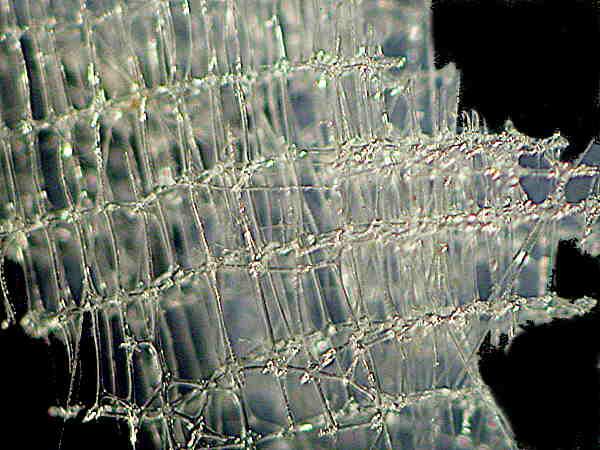
The intricate structure of a glass sponge, made of fused Siliceous spicules. I found a web page for amateur microscopists about Searching for Spicules.
Spongicola venustus is a shrimp with a symbiotic relationship with Euplectella spp.
The Love Story
In the following web page is explained that the shrimp's reproductive strategy is rational withing the sparse ecosystem of the deep sea: http://schmidtocean.org/cruise-log-post/a-deep-sea-love-story/The Shrimp: Spongicola venustus
Saito and Komai had this to say of the group of shrimps to which this species belongs:The symbiont spongicolid shrimps are generally characterized by a reduced armature of the body and appendages and by a rather depressed body form, representing a typical pattern of adaptation to a life in a confined space within the host animal (Bruce 1976). Furthermore, some of them show a trend toward reduction of the gills and exopods on maxillipeds

The drawing as well as the description are from
Saito, T. and Komai, T., 2008. A review of species of the genera Spongicola de Haan, 1844 and Paraspongicola de Saint Laurent & Cleva, 1981 (Crustacea, Decapoda, Stenopodidea, Spongicolidae). ZOOSYSTEMA-PARIS-, 30(1), p.87.
A remarkable series of images of the shrimp and the host sponge is found, in Korean, at the following site: http://sima-niger.net/kairodoketsu-133 .
The following image is taken from this site.

And here's the lid:
Subscribe to:
Posts (Atom)