Friday, February 23, 2018

Charles Darwin and earlier observers noticed "red water"

 March 18th. — We sailed from Bahia. A few days afterwards, when not far distant from the Abrolhos Islets, my attention was called to a reddish-brown appearance in the sea. The whole surface of the water, as it appeared under a weak lens, seemed as if covered by chopped bits of hay, with their ends jagged.
—Charles Darwin, The Voyage of the Beagle

 He credited a number of observers with earlier reports.  In his notes he mentions:

M. Lesson (Voyage de la Coquille, tom. i., p. 255) mentions red water off Lima, apparently produced by the same cause. Peron, the distinguished naturalist, in the Voyage aux Terres Australes, gives no less than twelve references to voyagers who have alluded to the discoloured waters of the sea (vol. ii. p. 239). To the references given by Peron may be added, Humboldt's Pers. Narr., vol. vi. p. 804; Flinder's Voyage, vol. i. p. 92; Labillardiere, vol. i. p. 287; Ulloa's Voyage; Voyage of the Astrolabe and of the Coquille; Captain King's Survey of Australia, etc.


In January 1915,  "Sea Sawdust" was reported by Earth Observatory:


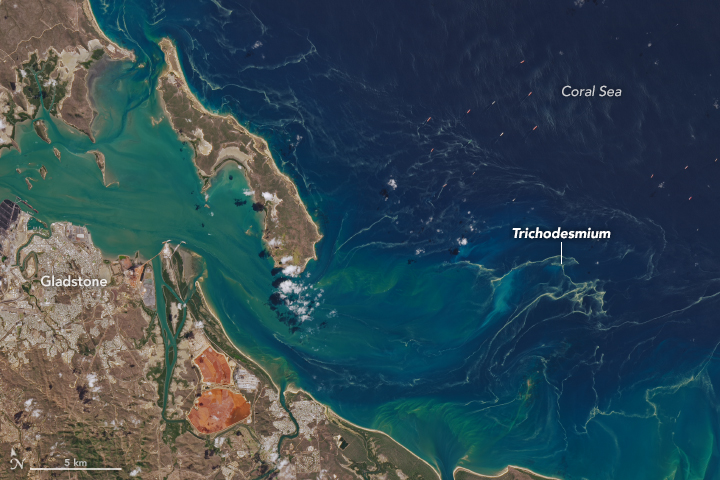
Another image from Landsat 8, taken on 11 September 2017 is featured here:

From that site:

The blooms are likely to be Trichodesmium spp., a microscopic, photosynthetic cyanobacteria that aggregates into long strands on the sea surface. They are ubiquitous around the world, and they tend to bloom off the coast of Queensland between August and December as the water warms. Some evidence suggests that Trichodesmium blooms here are happening earlier and more often in recent years.

From a ship or the shoreline, these blooms look like dirty brown or green stripes on the water and like an oil slick when they hit the beach. Such blooms off the Australian coast were reported two centuries ago by Captain James Cook and by Charles Darwin.

Up Close and In Person 

It was not possible to easily link the following site, with photos of Trichodesmium sp.  

 See the University of New Hampshire Phycokey.  


Monday, February 5, 2018

Behavior of Tides of San Francisco Bay

I'm not going to not write much about these graphs.  I had assumed that as one moves into the Bay, tide range would be attenuated.  So I was surprized to read the following bit from An Introduction to the San Francisco Estuary by Andrew Cohen and Jack Laws:

In the northern reach the tidal range (the difference in height between high water and low water) drops with distance from the ocean, from a mean range of about five-and-a-half feet at the Golden Gate to only three feet at Sacramento.    In contrast, in the southern reach’s more enclosed basin the tides cause the water to slosh back and forth like water in a bathtub, amplifying the range at the southern end to eight-and-one-half feet.

I wanted to explore this, so I graphed several sites in the Northern Reach, and five in the Southern Reach.  These are a work in progress.

The predictions that are graphed here are from Xtide: www.flaterco.com


In the legend, stations are listed  in order from the Entrance  to the most distant. 

"San Francisco" is the Fort Point station. 


Tuesday, December 26, 2017

"Inconcievably heavy snowfall" in Alaska's Banana Belt

 During my short time in Cordova, AK, I learned that Southern Alaska is "The Banana Belt" of Alaska.  It rained much, hardly ever did the sun shine, but if it snowed, it wasn't a great amount.  Our recent experience with climate/weather on the West Coast prompted this comment on the California Weather Blog:


"...  recently, the bigger & stronger West Coast ridge has pushed the Pacific storm track even further north. Remarkably, this powerful ridge has forced several very moist atmospheric river storms over the mid-Pacific to make a hard “left turn” over the open ocean–veering directly northward and bringing almost inconceivably heavy snowfall to the coastal mountains of southern Alaska."
The link it to an Anchorage Times article.


Thursday, December 21, 2017

Seasons: 23.44° Solstice "Sun Standing Still"

"Solstice" comes from the Latin word solstitium, meaning "sun standing still".


Wikipedia: "Solstice"

 The seasons occur because the Earth's axis of rotation is not perpendicular to its orbital plane (the “plane of the ecliptic”) but currently makes an angle of about 23.44° (called the "obliquity of the ecliptic"), and because the axis keeps its orientation with respect to an inertial frame of reference. As a consequence, for half the year the Northern Hemisphere is inclined toward the Sun while for the other half year the Southern Hemisphere has this distinction. The two moments when the inclination of Earth's rotational axis has maximum effect are the solstices.

 Wikipedia: Season

 In tropical and subtropical regions there is little annual fluctuation of sunlight. However, there are seasonal shifts of a rainy global-scale low pressure belt called the Intertropical convergence zone. As a result, the amount of precipitation tends to vary more dramatically than the average temperature. When the convergence zone is north of the equator, the tropical areas of the northern hemisphere experience their wet season while the tropics south of the equator have their dry season. This pattern reverses when the convergence zone migrates to a position south of the equator.

Tuesday, October 3, 2017

It is impossible that humans will engineer an airtight security system of any kind

It is Impossible!

Human intellect evolved to solve problems, leading to incremental advancements of knowledge.  Note the plethora of innovations that were independently invented simultaneously or nearly simultaneously.  Tim Wu has developed this idea in his book about eyeballs: _The Attention Merchants_.  Industrial Psychologists have understood something like this for a long time: error rates in assembly lines increase over the shift.  There are limits.  Remember the unsinkable ship and prisons from which it would be impossible to escape? 

Why is it a surprize that major online databases are hackable? 

I take it that the human brain lacks the capacity to understand any system sufficiently well to foresee any or all possible shortcomings of that system. 

What are the philosophical ramifications of my statement?