The Anti-PowerPoint Party
Tim Wu: Democrats' Complexity Problem
Phenology
- 2005 Report of Long Term Trends. (From JMA)
(This) may imply that the Bali-Javanese year originally had onlyI will quote this much longer fragment, without much correction:
10 months (cf. Ginzel, op. cit. p. 425) — a curious phenomenon
which is recorded for the Gilbert Islands by Hale (il.S. Explor-
ing Expedition, Ethnography and Philology, Philadelphia,
1S46, p. 105 f.), and is seen also among the Maori and possibly
in the Caroline Islands, although, as Gerland (Anthrop. der
Natürvölker, Leipzig, 1860-77, vi. 72 1.) well urges, all these
cases of alleged ten-month years may be based on error. At the
same time, one involuntarily thinks of the Roman tradition that
previous to Numa, who added Jan. and Feb., the year con-
sisted of only ten months (of. Plutarch, Vita Numce, xvlii. £.,
and see below, p. 134a).
In Melanesia the system of reckoning time is most primitive. The standard of measure is, of course, the moon, but there is no indigenous concept of the year; tau or niulu, commonly used for 'year,' properly connoting only 'season' (as the 'tau of the yam,' the banana having no tau, since it is in fruit throughout the year).
'It is impossible to fit the native succession of moons into a solar year; months have their names from what is done and what happens when the moon appears and while it lasts; the same moon has different names' (Codrington, ilelanesians, Oxford, 1891, p. 349). For example, the moons of the year on Mota, of the Banks Islands group, may be given as follows : Magoto garo ('fresh grass,' corresponding to April), Magoto rango ('withered grass'), Nago rara ('face of winter,' the rara, or
Erythrina, flowering in the cold season), Tur rara ('fullness of winter'), Kere rara ('end of winter'), Un rig or Un gogona ('little or bitter palolo,' a few of these annelids appearing at this full moon), Un lava ('great palolo,' the annelid appearing on the reef in immense numbers on one night at full moon, this serving in part as the beginning of a new year, especially as the yam is harvested during this moon), Un werei ('rump of the palolo'), Vule wotgoro ('moon of shooting up'
[of the reeds into flower]), Vusiaru (when the wind beats the casuarina trees on the cliffs), Tetemavuru (when the hard winds detach fragments from the seeded reeds), and Lamasag noronoro ('rattling of dry reeds'),
In the Caroline Islands a phenomenon is found, which is, in a sense, characteristic of the Pacific calendar, and which outside this region occurs only in the Armenian and Persian systems (see above, pp. 70, 128) — the naming of the days of each month or moon. In Ponape, for example, the names of the 27 days of the moon are as follows (Christian, Caroline Islands, London, 1899, p. 387 f . ) : Ir, Lel- eti, Chanok, Chanok-en-komóni, Chanok-en-komána, Epenok-omur, Epenok-omoa, Chaii-pot-mur,
Chau-pot-moa, Arichau, Chutak-ran, Eü, Aralok, At, Arre, Echil, Apang, Alim, Aon, Eich, Aval, Malatuatu, Takai-en-pai, Aro-puki, Olo-pua, Olomal, and Mat (similar lists for Lamotrek, the Mortlock Islands, Yap, and Uleai are given by Christian, op. cit. pp. 392-395). In Ponape, moreover, as elsewhere in the Carolines, the month is divided into 3 parts: Rot ('darkness,' 13 days), Mach ('new moon,' 9 days), and Pul ('waning moon,' 5 days). The number of months in the Caroline year is 12 (in
Lamotrek, for example, Sarabol, Aramaus, Tumur, Mai-rik, Mai-lap, Seuta, Lahk, Ku, Ul, Alliel, Man, and Ich); and Freycinet's record of only 10 (Voyage autour du monde, Paris, 1827-29, ii. 105) — Tungur, Mol, Mahelap, Sota, La, Kuhu, Halimatu, Margar, Hiolikol, and Mal — was probably based, as he himself suspected, on erroneous information, especially as each maram ('moon,' 'month') possessed but 30 days. In the Ladrones the same explorer (op. cit. p. 380) found 13 lunar months (pulan)
in the year (sakkan) : Tumeguini, Maine, Umotaraf, Lumuhu, Magmamao, Mananaf, Semo, Tenhos, Lumamlam, Fagualu, Sumongsugn, Umadjanggan, and Umagahaf; and in the same group Chamisso ('Bemerkungen auf einer Entdeckungsreise,' Gesammelte Werke, Cotta ed. iv. 285) found time reckoned by days and moons, but in the Carolines by nights and moons.
Throughout Polynesia time was reckoned by the moon, from 28 to 30 nights forming the month, of which there were, as occasion required, 12 or 13 in the year. This year (or, rather, annual season, for the concept 'year' was scarcely known in its strict sense in Polynesia) began at various periods corresponding to our May, June, March, late December, etc., while the names of the months varied from island to island, and even within the same island (cf. Ellis, Polynesian Researches^, London,
1832-36, i. 86-89; for further details, with abundant references to older literature, see Gerland, op. cit. p. 71ff.).
In Tahiti, where the year (táoo) began about March, the months (marama, malama) bore, accord- ing to Forster (Observations made during a Voyage around the World, London, 1778, p. 504f.), the following names (cf. the slightly divergent list in Hale, op. cit. p. 169 f., where lists for Samoa and Hawaii are also recorded): O-porore-o-moòa, 0-porore-o-moòree, Moorehà, Oohee-eìya, Hooree-àma, Tàuwa, Hooree-erre-èrre, 0-te-àree, 0-te-taì, Warehoo, Woeahou, Pipìrree, and A-oo-noonoo. Each month had 29 days, all with individual names, special names also being borne by each of the six divisions of the day and the six of the night. In Lakemba, in the Fiji group, the 11 months recorded by Hale (op. cit. p. 6)— Sese-ni-ngasáu-lailai ('little reed-flower,' corresponding to Feb.), Sese-ni-ngasáu-levu ('great reed-flower'), Vulai-mbotambota ('moon of scattering' [the fallen leaves]), Vulai-kelikeli ('moon of digging'), Kawakatangāre, Kawawakā-lailai, Kawawakā-levu (these three referring to the growth of the yam), Mbalolo-lailai ('little palolo' [for the allusion, cf. preceding col.]), Mbalolo-levu ('great palolo'), Nunga-lailai ('little nunga' [a sort of fish]), and Nunga-levu ('great nunga') — recall by their grouping the seasonal nomenclature of the oldest Indian months — Sukra ('bright'), Suci ('burning'); Nabhas ('cloud'), Nabhasya, ('cloudy'); Tapas ('warmth'), Tap-asya ('warm'); etc. (Ginzel, op. cit. p. 316). In Rotuma Island, belonging to Fiji, we find a 'monsoon year' of 6 moons, the months being repeated semi-annually on account of the regular blowing of westerly and easterly winds: Oipapa (March, September), Taftáfi, Hāua, Kasépi, Fāson-hāu, and Aθapuána (Hale, op. cit. p. 169).
With this may perhaps be compared the Nicobarese custom of reckoning by the south-west monsoon (sho-hong, May-Oct.) and the north-east monsoon (fūl, Nov.-April), two shom-en-yuh, or monsoon half years, making approximately a solar year. At the same time, the kāhēs (new moons) are named consecutively throughout the year, not repeated semi-annually as in Rotuma (see, further, Ginzel, op. cit. p. 431 f.). In the Society Islands the year (matahiti) was similarly divided into half-years according
to the position of the Pleiades: Matarii i nia ('Pleiades above' [the horizon]), and Matarii i raro ('Pleiades below' [the horizon]). Here again the nights of each lunar month, which were, as necessity required, 12 or 13 in number, and had 30 days each, were named individually, while various seasons (as Tetau, 'autumn'; Te-tau-miti-rati, 'time of high sea'; and Te-tau-poai, 'season of drought and scarcity') were also recognized. Ellis (loc. cit. ) further states that, while the
Society Islanders were unacquainted with hours or weeks, they 'marked the progress of the day with sufficient accuracy, by noticing the position of the sun in the firmament, the appearance of the atmosphere, and the ebbing and flowing of the tide.' In like fashion the Hawaiians began their year when the Pleiades rise at sunset. During five months, beginning with Kaelo (Jan.), war might be waged, but peace was enjoined during the remainder of the year. Similarly in Tahiti, according to Wilkes
(Narrative of U.S. Exploring Expedition, Philadelphia, 1850, iv. 42 f.), the first three months were for war; during the fourth the opelu was tabu, and in the fifth it was caught; the two moons following were for taxing; the eighth was devoted to prayers, games, and merriment; the ninth contained the annual feast for the payment of taxes; in the tenth the idols were carried about, and taxes were demanded; the eleventh was for the offerings to the dead and the catching of the boneta; and
the twelfth for the fishing of the same fish. Elsewhere each month had analogous divisions. Thus, in Hawaii,
'during each month there were four tabu periods of two nights and one day each, dedicated severally to each of the four great gods. All their religious rites, as well as their fishing, planting, etc., were regulated by the moon' (Alexander, Brief Hist, of the Hawaiian People, New York, 1891, p. 49 f.).
In New Zealand the year also began with the rising of the Pleiades. According to Maori tradition, this year (tau, lit. 'season') originally contained only ten months, until Whare-patari, a magician, taught the people better (cf. the curiously parallel tradition of Numa, above, p. 132^a), after which they had the customary Polynesian number of 12 or 13: Te-tahi (June), Te-rua, Te-toru, Te-wha, Te-rima, Te-ono, Te-whitu, Te-waru, Te-iwa, Te-ngahuru, Te-ngahuru-tahi, Te-ngahuru-rua, and
Te-ngahuru-tahi-aralua (Shortland, Traditions and Superstitions of the New Zealanders ^2, London, 1856, pp. 219-222). These months had the following names for their days (Tregear, Maori-Polynesian Comparative Diet., Wellington, 1891, p. 666, where similar lists are given for Hawaii, Tahiti, Rarotonga, and the Marquesas): Whiro (from whiri, 'twist,' 'plait,' because on this first night the moon looks like a twisted thread), Tirea (cf. tirau, 'peg,' 'stick'), Hoata ('long spear'). One,
Okou (cf. oka, 'wooden bowl or other open vessel' [?]), Tamatea-kai-ariki, Tamatea-ananga, Tamatea-aio, Tamatea-whakapau, Huna, Ari-roa, Mawharu, Maurea, Atua-whakahaehae, Turu, Rakau-nui, Rakau-matohi, Takirau, Oika, Korekore, Korekore-turua, Korekore-piri-ki-Tangaroa, Tangaroa-a-mua, Tangaroa-a-roto, Tangaroa-a-kiokio, O-Tane (sacred to Tane), O-Rongo-nui (sacred to Rongo), Mauri, 0-Mutu, and Mutuwhenua (cf. mutu, 'brought to an end').
In Australia, as one would expect, the lowest degree of calendrical development in the Pacific region is found. Here, in the words of Spencer-Gillen, p. 25 f.,
'time is counted by "sleeps" or "moons," or phases of the moon, for which they have definite terms : longer periods they reckon by means of seasons, having names for summer and winter. They have further definite words expressing particular times, such as morning before sunrise (ingwunthagwuntha), ... day after tomorrow (ingwunthairpina), ... in a long time (ingwuntha arbarmaninga).'
The citation of additional data from the remainder of the Pacific world would scarcely add new principles to the Polynesian calendar, which may DC described, from the evidence already presented, as a system of lunar months (or 'moons'), 12 or 13 to what we should call a year (a concept developed only imperfectly, if at all, by the peoples under consideration), usually named according to the natural phenomena, the occupations, or the religious festivals connected with them, and — in many places subdivided into two or three periods of unequal length — having from 28 to 30 days, only roughly divided into parts (aiiy thing corresponding to the hour being quite unknown), but normally named each with a special designation — the latter being, in fact, the most striking superficial characteristic of this entire system of the reckoning of time.
LITERATURE. — Abundant references, in addition to those mentioned in the art., may be found in Waitz-Gerland, Anthropol. der Naturvolker, Leipzig, 1860-77, v. a, 125, b, 86, vi. 71-74, 613-615, 763 f.; Ginzel, Handbuch der mathemat. und techn. Chronologie, Leipzig, 1906, i. 414-432, 449.
In Melanesia the system of reckoning time is most primitive. The standard of measure is, of course, the moon, but there is no indigenous concept of the year; tau or niulu, commonly used for 'year,' properly connoting only 'season' (as the 'tau of the yam,' the banana having no tau, since it is in fruit throughout the year).
'It is impossible to fit the native succession of moons into a solar year; months have their names from what is done and what happens when the moon appears and while it lasts; the same moon has different names' (Codrington, ilelanesians, Oxford, 1891, p. 349). For example, the moons of the year on Mota, of the Banks Islands group, may be given as follows : Magoto garo ('fresh grass,' corresponding to April), Magoto rango ('withered grass'), Nago rara ('face of winter,' the rara, or
Erythrina, flowering in the cold season), Tur rara ('fullness of winter'), Kere rara ('end of winter'), Un rig or Un gogona ('little or bitter palolo,' a few of these annelids appearing at this full moon), Un lava ('great palolo,' the annelid appearing on the reef in immense numbers on one night at full moon, this serving in part as the beginning of a new year, especially as the yam is harvested during this moon), Un werei ('rump of the palolo'), Vule wotgoro ('moon of shooting up'
[of the reeds into flower]), Vusiaru (when the wind beats the casuarina trees on the cliffs), Tetemavuru (when the hard winds detach fragments from the seeded reeds), and Lamasag noronoro ('rattling of dry reeds'),
In the Caroline Islands a phenomenon is found, which is, in a sense, characteristic of the Pacific calendar, and which outside this region occurs only in the Armenian and Persian systems (see above, pp. 70, 128) — the naming of the days of each month or moon. In Ponape, for example, the names of the 27 days of the moon are as follows (Christian, Caroline Islands, London, 1899, p. 387 f . ) : Ir, Lel- eti, Chanok, Chanok-en-komóni, Chanok-en-komána, Epenok-omur, Epenok-omoa, Chaii-pot-mur,
Chau-pot-moa, Arichau, Chutak-ran, Eü, Aralok, At, Arre, Echil, Apang, Alim, Aon, Eich, Aval, Malatuatu, Takai-en-pai, Aro-puki, Olo-pua, Olomal, and Mat (similar lists for Lamotrek, the Mortlock Islands, Yap, and Uleai are given by Christian, op. cit. pp. 392-395). In Ponape, moreover, as elsewhere in the Carolines, the month is divided into 3 parts: Rot ('darkness,' 13 days), Mach ('new moon,' 9 days), and Pul ('waning moon,' 5 days). The number of months in the Caroline year is 12 (in
Lamotrek, for example, Sarabol, Aramaus, Tumur, Mai-rik, Mai-lap, Seuta, Lahk, Ku, Ul, Alliel, Man, and Ich); and Freycinet's record of only 10 (Voyage autour du monde, Paris, 1827-29, ii. 105) — Tungur, Mol, Mahelap, Sota, La, Kuhu, Halimatu, Margar, Hiolikol, and Mal — was probably based, as he himself suspected, on erroneous information, especially as each maram ('moon,' 'month') possessed but 30 days. In the Ladrones the same explorer (op. cit. p. 380) found 13 lunar months (pulan)
in the year (sakkan) : Tumeguini, Maine, Umotaraf, Lumuhu, Magmamao, Mananaf, Semo, Tenhos, Lumamlam, Fagualu, Sumongsugn, Umadjanggan, and Umagahaf; and in the same group Chamisso ('Bemerkungen auf einer Entdeckungsreise,' Gesammelte Werke, Cotta ed. iv. 285) found time reckoned by days and moons, but in the Carolines by nights and moons.
Throughout Polynesia time was reckoned by the moon, from 28 to 30 nights forming the month, of which there were, as occasion required, 12 or 13 in the year. This year (or, rather, annual season, for the concept 'year' was scarcely known in its strict sense in Polynesia) began at various periods corresponding to our May, June, March, late December, etc., while the names of the months varied from island to island, and even within the same island (cf. Ellis, Polynesian Researches^, London,
1832-36, i. 86-89; for further details, with abundant references to older literature, see Gerland, op. cit. p. 71ff.).
In Tahiti, where the year (táoo) began about March, the months (marama, malama) bore, accord- ing to Forster (Observations made during a Voyage around the World, London, 1778, p. 504f.), the following names (cf. the slightly divergent list in Hale, op. cit. p. 169 f., where lists for Samoa and Hawaii are also recorded): O-porore-o-moòa, 0-porore-o-moòree, Moorehà, Oohee-eìya, Hooree-àma, Tàuwa, Hooree-erre-èrre, 0-te-àree, 0-te-taì, Warehoo, Woeahou, Pipìrree, and A-oo-noonoo. Each month had 29 days, all with individual names, special names also being borne by each of the six divisions of the day and the six of the night. In Lakemba, in the Fiji group, the 11 months recorded by Hale (op. cit. p. 6)— Sese-ni-ngasáu-lailai ('little reed-flower,' corresponding to Feb.), Sese-ni-ngasáu-levu ('great reed-flower'), Vulai-mbotambota ('moon of scattering' [the fallen leaves]), Vulai-kelikeli ('moon of digging'), Kawakatangāre, Kawawakā-lailai, Kawawakā-levu (these three referring to the growth of the yam), Mbalolo-lailai ('little palolo' [for the allusion, cf. preceding col.]), Mbalolo-levu ('great palolo'), Nunga-lailai ('little nunga' [a sort of fish]), and Nunga-levu ('great nunga') — recall by their grouping the seasonal nomenclature of the oldest Indian months — Sukra ('bright'), Suci ('burning'); Nabhas ('cloud'), Nabhasya, ('cloudy'); Tapas ('warmth'), Tap-asya ('warm'); etc. (Ginzel, op. cit. p. 316). In Rotuma Island, belonging to Fiji, we find a 'monsoon year' of 6 moons, the months being repeated semi-annually on account of the regular blowing of westerly and easterly winds: Oipapa (March, September), Taftáfi, Hāua, Kasépi, Fāson-hāu, and Aθapuána (Hale, op. cit. p. 169).
With this may perhaps be compared the Nicobarese custom of reckoning by the south-west monsoon (sho-hong, May-Oct.) and the north-east monsoon (fūl, Nov.-April), two shom-en-yuh, or monsoon half years, making approximately a solar year. At the same time, the kāhēs (new moons) are named consecutively throughout the year, not repeated semi-annually as in Rotuma (see, further, Ginzel, op. cit. p. 431 f.). In the Society Islands the year (matahiti) was similarly divided into half-years according
to the position of the Pleiades: Matarii i nia ('Pleiades above' [the horizon]), and Matarii i raro ('Pleiades below' [the horizon]). Here again the nights of each lunar month, which were, as necessity required, 12 or 13 in number, and had 30 days each, were named individually, while various seasons (as Tetau, 'autumn'; Te-tau-miti-rati, 'time of high sea'; and Te-tau-poai, 'season of drought and scarcity') were also recognized. Ellis (loc. cit. ) further states that, while the
Society Islanders were unacquainted with hours or weeks, they 'marked the progress of the day with sufficient accuracy, by noticing the position of the sun in the firmament, the appearance of the atmosphere, and the ebbing and flowing of the tide.' In like fashion the Hawaiians began their year when the Pleiades rise at sunset. During five months, beginning with Kaelo (Jan.), war might be waged, but peace was enjoined during the remainder of the year. Similarly in Tahiti, according to Wilkes
(Narrative of U.S. Exploring Expedition, Philadelphia, 1850, iv. 42 f.), the first three months were for war; during the fourth the opelu was tabu, and in the fifth it was caught; the two moons following were for taxing; the eighth was devoted to prayers, games, and merriment; the ninth contained the annual feast for the payment of taxes; in the tenth the idols were carried about, and taxes were demanded; the eleventh was for the offerings to the dead and the catching of the boneta; and
the twelfth for the fishing of the same fish. Elsewhere each month had analogous divisions. Thus, in Hawaii,
'during each month there were four tabu periods of two nights and one day each, dedicated severally to each of the four great gods. All their religious rites, as well as their fishing, planting, etc., were regulated by the moon' (Alexander, Brief Hist, of the Hawaiian People, New York, 1891, p. 49 f.).
In New Zealand the year also began with the rising of the Pleiades. According to Maori tradition, this year (tau, lit. 'season') originally contained only ten months, until Whare-patari, a magician, taught the people better (cf. the curiously parallel tradition of Numa, above, p. 132^a), after which they had the customary Polynesian number of 12 or 13: Te-tahi (June), Te-rua, Te-toru, Te-wha, Te-rima, Te-ono, Te-whitu, Te-waru, Te-iwa, Te-ngahuru, Te-ngahuru-tahi, Te-ngahuru-rua, and
Te-ngahuru-tahi-aralua (Shortland, Traditions and Superstitions of the New Zealanders ^2, London, 1856, pp. 219-222). These months had the following names for their days (Tregear, Maori-Polynesian Comparative Diet., Wellington, 1891, p. 666, where similar lists are given for Hawaii, Tahiti, Rarotonga, and the Marquesas): Whiro (from whiri, 'twist,' 'plait,' because on this first night the moon looks like a twisted thread), Tirea (cf. tirau, 'peg,' 'stick'), Hoata ('long spear'). One,
Okou (cf. oka, 'wooden bowl or other open vessel' [?]), Tamatea-kai-ariki, Tamatea-ananga, Tamatea-aio, Tamatea-whakapau, Huna, Ari-roa, Mawharu, Maurea, Atua-whakahaehae, Turu, Rakau-nui, Rakau-matohi, Takirau, Oika, Korekore, Korekore-turua, Korekore-piri-ki-Tangaroa, Tangaroa-a-mua, Tangaroa-a-roto, Tangaroa-a-kiokio, O-Tane (sacred to Tane), O-Rongo-nui (sacred to Rongo), Mauri, 0-Mutu, and Mutuwhenua (cf. mutu, 'brought to an end').
In Australia, as one would expect, the lowest degree of calendrical development in the Pacific region is found. Here, in the words of Spencer-Gillen, p. 25 f.,
'time is counted by "sleeps" or "moons," or phases of the moon, for which they have definite terms : longer periods they reckon by means of seasons, having names for summer and winter. They have further definite words expressing particular times, such as morning before sunrise (ingwunthagwuntha), ... day after tomorrow (ingwunthairpina), ... in a long time (ingwuntha arbarmaninga).'
The citation of additional data from the remainder of the Pacific world would scarcely add new principles to the Polynesian calendar, which may DC described, from the evidence already presented, as a system of lunar months (or 'moons'), 12 or 13 to what we should call a year (a concept developed only imperfectly, if at all, by the peoples under consideration), usually named according to the natural phenomena, the occupations, or the religious festivals connected with them, and — in many places subdivided into two or three periods of unequal length — having from 28 to 30 days, only roughly divided into parts (aiiy thing corresponding to the hour being quite unknown), but normally named each with a special designation — the latter being, in fact, the most striking superficial characteristic of this entire system of the reckoning of time.
LITERATURE. — Abundant references, in addition to those mentioned in the art., may be found in Waitz-Gerland, Anthropol. der Naturvolker, Leipzig, 1860-77, v. a, 125, b, 86, vi. 71-74, 613-615, 763 f.; Ginzel, Handbuch der mathemat. und techn. Chronologie, Leipzig, 1906, i. 414-432, 449.
I'm going to become more self-centered about this blog. Cookie crumbs for my own amazement and learning. I am planning to start a new blog devoted to all matters relating to tides. Such websites and articles abound. Yet another one. In the time being (a phrase that means "for now"), I will incorporate these posts into this all purpose blog.
My fascination for the Tides is inexplicable to even me. My Mother used to take us to Hendry's Beach where we would play in the sand at the shoreline, sure; but a quantum jump for me was a field trip for my Kindergarten class to Devereaux Point (also known as Coal Oil Point, because of random tar blobs from offshore seeps, scattered around the beach.) But on that early morning, as the morning light began to wax, it was the denizens of the tide pools that caught my fancy.
And catch my fancy they did, and more. I will never forget the squishing of the sea anemones under my feet. I don't remember, but it seems I might have been bare-footed that morning. I don't remember my teacher's name---though I might be able to dig it out one day. She taught me some lessons, on several levels, beginning on that morning.
After the field trip, we had at least one direct lesson about Coelenterata. That was a lesson I will not forget. But the greater lesson for me, as a teacher, is that we often---no, usually---underestimate kids. Our teacher actually showed us diagrams of the internal anatomy of polyps, and made it clear there are three layers of the body wall. She also opened out eyes to alternation of generation in the Coelenterata, which stuck with me even though sea anemones do not exhibit this characteristic. Looking back, the sophistication of the background she gave us was remarkable; and at the University, the lessons she taught us gave me a leg up. I was totally at ease with these concepts.
That anemone, I was later to learn, was Anthopleura elegantissima, the first object of my life-long love affair with the Coelenterates. Beyond the anemones, the Cnidaria (as the Coelenterates have now been renamed) have held my fascination through the years. Of this much more could might be said, but most importantly, I came to study at the University of Guam as a graduate student, where I studied the Hydrozoan coral, Millepora platyphylla, Fire Corals, a most remarkable species.
But for now, this is about my wonderment with tides, and how and where my fascination with tides took root. No matter where, the tides have held an important hold on me, in many aspects. The Intertidal Zone, and "minus tides" grew to a special place of prominence in my mind.
There are many personal stories to be told, some more compelling than others, certainly. Recently I have come to a closer examination of the science of the tides.
For starters, I have found the following link to be amazing.
[This web site is no longer available.]
http://volkov.oce.orst.edu/tides/
[This site is available (3 August 2022)]
OSU Tide Model Daily global tides animation.
Usually, the first time I have visited this URL, it works for a few minutes (the animation) but stops after awhile, and cannot be resumed. I was then able to either visit it in a different browser for awhile, or restart my browser and visit again.
I am not sure I understand it correctly. I believe it is a global prediction of the tidal wave, generated by astronomical forces, sloshing around the oceans. Here is the reference:
Egbert,
Gary D., and Svetlana Y. Erofeeva. "Efficient inverse modeling of
barotropic ocean tides." Journal of Atmospheric and Oceanic Technology
19.2 (2002): 183-204.
"nonprofit organization that advocates for a "healthy" internet. Its mission is to help build an internet in an open-source manner that's accessible to everyone -- and where privacy and security are built in."
Again from Nettle and Romaine:
Some languages have a distinct grammatical category of evidentiality that is required to be expressed at all times. The elements in European languages indicating the information source are optional and usually do not indicate evidentiality as their primary function — thus they do not form a grammatical category. The obligatory elements of grammatical evidentiality systems may be translated into English, variously, as I hear that, I see that, I think that, as I hear, as I can see, as far as I understand, they say, it is said, it seems, it seems to me that, it looks like, it appears that, it turns out that, alleged, stated, allegedly, reportedly, obviously, etc.
Languages like Turkish, Kwakiutl, Navajo, and Hopi have different conjugations of the verb which distinguish heasay from what is the speaker's own knowledge.Nettle and Romaine quote the following by "a European explorer" about the languages of Rossel Island, Papua New Guinea.
Any that we heard were scarcely like human speech in sound, and were evidently very poor and restricted in expression. Noises like sneezes, snarls and the preliminary stages of choking---impossible to reproduce on paper---represented the names of villages, people, and things.
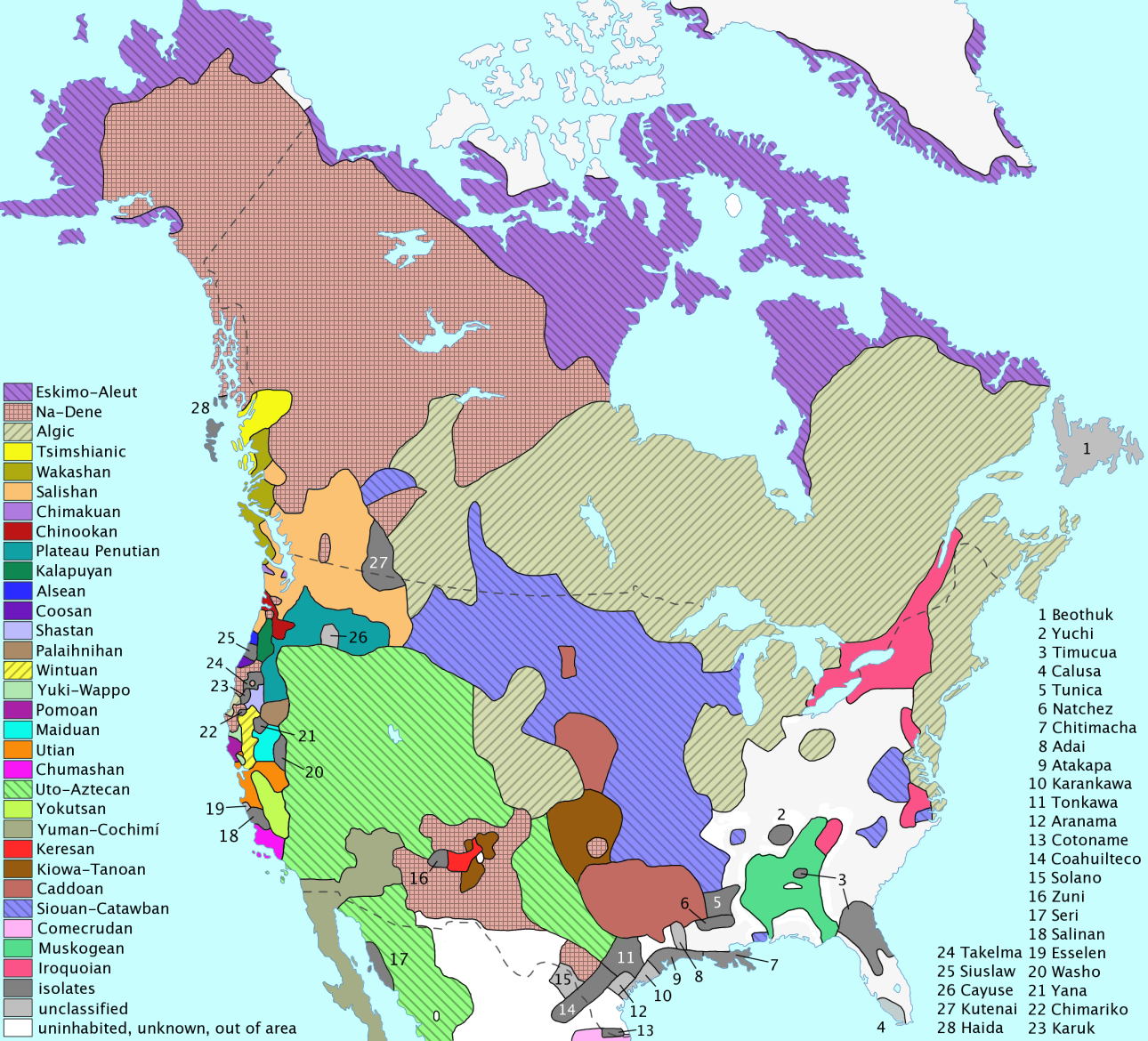 |
| North American languages at the time of colonization. |
From Wikipedia:
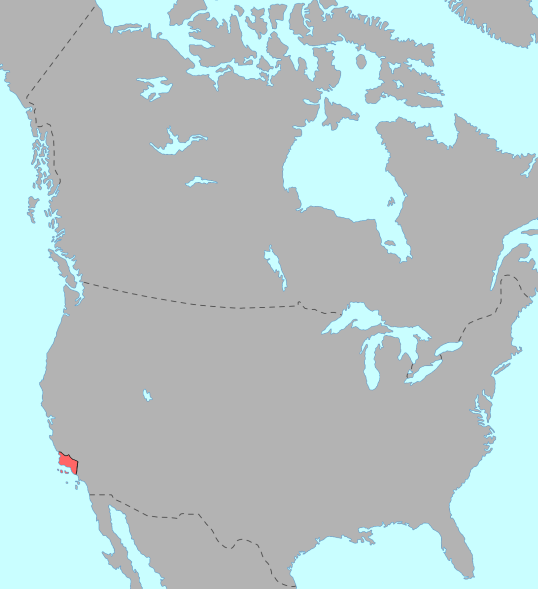
Chumashan (meaning "Santa Cruz Islander") is a family of languages that were spoken on the southern California coast by Native American Chumash people, from the Coastal plains and valleys of San Luis Obispo to Malibu, neighboring inland and Transverse Ranges valleys and canyons east to bordering the San Joaquin Valley, to three adjacent Channel Islands: San Miguel, Santa Rosa, and Santa Cruz.[2]The Chumashan languages may be, along with Yukian and perhaps languages of southern Baja such as Waikuri, one of the oldest language families established in California, before the arrival of speakers of Penutian, Uto-Aztecan, and perhaps even Hokan languages. Chumashan, Yukian, and southern Baja languages are spoken in areas with long-established populations of a distinct physical type. The population in the core Chumashan area has been stable for the past 10,000 years. However, the attested range of Chumashan is recent (within a couple thousand years). There is internal evidence that Obispeño replaced a Hokan language and that Island Chumash mixed with a language very different from Chumashan; the islands were not in contact with the mainland until the introduction of plank canoes in the first millennium AD.[3]
Although the JMA still officially declares the start of cherry blossom blooming, it stopped its forecasts in 2010, due in part to the increased accuracy of the private companies.
One of those companies, Tokyo-based Weather Map Co., has updated its forecasts twice a week in March, based on an analysis of the official somei-yoshino cherry trees used by the JMA at 53 locations around Japan.

